


Sales reps spend an average of eight hours per week on post-call admin. That’s a full working day lost to writing up notes, updating the CRM, and chasing action items before they’ve made a single new call.
It adds up to something more serious than inconvenience. When note-taking splits your attention during a call, you miss the signals that close deals. The prospect hesitates on price and you’re too busy writing to notice. A competitor gets mentioned in passing and it doesn’t make it into the CRM. The next step gets agreed but nobody captures exactly who owns it.
AI note takers for sales calls solve both problems at once. They record and transcribe automatically, so you stay present during the conversation. Then they produce a structured summary, extract action items, and in many cases update your CRM directly before you’ve moved on to the next call.
According to Gartner, manual CRM data entry is the single largest time drain for sales teams. The tools below cut it significantly. Here’s what’s worth using in 2026.
1. Bluedot — Best Overall for Client-Facing Sales Teams
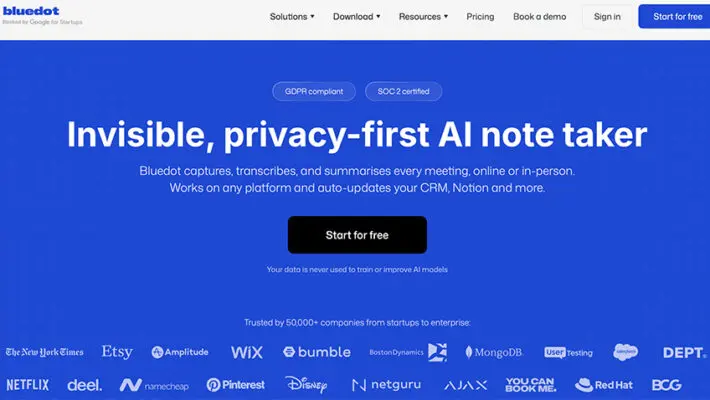
Bluedot AI Note Taker is bot-free, which matters more on sales calls than almost anywhere else. Most note-taking tools join your call as a named participant “AI Notetaker has entered the meeting” which creates an awkward moment with prospects who weren’t expecting it. Bluedot records through a Chrome extension or desktop app, entirely on your end, with nothing appearing in the attendee list.
For sales teams whose calls involve first impressions and trust-building, this removes a friction point that most tools simply ignore.
The transcription covers 100+ languages, which is increasingly relevant as sales teams work across markets and prospects join from different countries. Summaries are structured and ready to use, and an AI chatbot lets you search across your entire call history “what did the prospect at [company] say about their current supplier?” and get a direct answer rather than hunting through transcripts.
Transcripts stay private by default, which matters when your calls contain pricing discussions, competitive positioning, or information you’d rather not auto-distribute. The Business plan integrates directly with Salesforce and HubSpot, pushing meeting notes into deal records automatically.
iOS and Android apps cover in-person sales meetings and site visits, not just video calls.
Pricing: Free plan (5 lifetime meetings). Basic from £11/user/month. Business plan (CRM integrations) from £26/user/month.
Best for: Sales teams where call tone and client rapport matter, and where a visible recording bot would create friction.
| Pros | Cons |
| Bot-free — nothing appears in the attendee list | Free plan: 5 lifetime meetings only |
| 100+ languages for global sales teams | CRM integration requires Business plan |
| Transcripts private by default | |
| AI search across full call history | |
| iOS and Android apps for in-person meetings | |
| Direct CRM sync with Salesforce and HubSpot |
2. Fireflies AI — Best for CRM Automation
Fireflies AI is built around one core promise: every sales call ends with your CRM already updated. It joins via a bot, transcribes in real time, and then automatically pushes notes, action items, and call summaries into Salesforce, HubSpot, Pipedrive, and 200+ other tools — without anyone touching a keyboard.
For sales teams where CRM hygiene is a persistent problem — where reps skip updates because they’re in back-to-back calls, or where deal records are patchy because notes never made it across — Fireflies addresses this structurally rather than through better habits.
The AskFred AI lets you query your entire call library across the whole team, not just your own calls. A manager can ask “what objections have come up most in discovery calls this month?” and get an answer from the data rather than polling the team in a meeting.
Sentiment analysis adds a layer beyond transcript accuracy: post-call breakdowns of how engaged the prospect was, which moments triggered a change in tone, and where the conversation shifted.
Fireflies explicitly does not train AI models on your meeting data, which addresses one of the more serious concerns around sensitive sales conversations.
Pricing: Free (800 minutes storage). Pro from £8/user/month (annually). Business from £15/user/month.
Best for: Sales teams running high call volumes who need CRM updates to happen automatically without relying on reps to do it manually.
| Pros | Cons |
| CRM auto-update: Salesforce, HubSpot, Pipedrive, 200+ tools | Visible bot joins every call |
| Sentiment analysis after each call | Credit-based AI features deplete quickly on busy teams |
| AskFred AI queries across full team call library | Auto-sharing defaults need adjusting |
| 100+ languages | |
| Does not train AI on your call data |
3. Fathom — Best Free Starting Point
Fathom offers the most generous free plan in this category: unlimited recording, unlimited transcription, and unlimited storage at no cost. No credit card, no monthly cap, no expiry date.
For a small sales team testing whether AI note-taking actually improves their workflow before committing to a subscription, this is the lowest-risk entry point available. Summaries arrive quickly — roughly 30 seconds after a call ends — and 15+ pre-built templates include formats specifically for sales calls, discovery conversations, and client check-ins.
The limitations are real but specific. Fathom uses a visible bot, so clients on the call will see it. There’s no mobile app, which rules out in-person meetings. CRM field-level sync requires the Business plan at £20/user/month. And AI summaries on the free plan are capped at 5 per month before the format steps down.
For teams that primarily sell over video and want to eliminate post-call note-writing at zero upfront cost, Fathom is the obvious first tool to try.
Pricing: Free forever (unlimited recordings, 5 AI summaries/month). Premium from £13/month. Business from £20/user/month for CRM sync.
Best for: Early-stage sales teams and individual reps who want to start saving time on call documentation without a subscription commitment.
| Pros | Cons |
| Genuinely free — unlimited recordings, no time limit | Visible bot in every call |
| 30-second summaries after calls end | No mobile app — in-person not covered |
| Sales call summary templates included | AI summaries: 5/month on free plan |
| SOC 2, GDPR, HIPAA compliant | CRM sync requires Business tier |
| Does not train AI on your data | 28 languages only |
4. Avoma — Best for Sales Coaching and Team Management
Avoma sits in a different category from the other tools on this list. Where Bluedot and Fathom focus on capture and documentation, Avoma is built around coaching: using call data to improve how your team sells, not just to record what was said.
After every call, Avoma produces transcripts and summaries alongside structured analytics: talk-time ratios, question frequency, competitor mentions, and adherence to your sales methodology. Managers can review calls without watching full recordings, identify coaching opportunities at scale, and track whether reps are actually following MEDDIC, BANT, or whatever framework the team uses.
AI-generated coaching scorecards after each call give managers a consistent, objective basis for feedback — which is particularly valuable for SME sales leaders who can’t sit in on every call but need to know where deals are stalling and why.
Avoma integrates with Salesforce, HubSpot, and Pipedrive, and provides a 14-day free trial with full feature access.
The trade-off is complexity and cost. Avoma’s pricing is modular — the base AI Meeting Assistant plan is required for all users, with Conversation Intelligence and Revenue Intelligence as add-ons. For a small team that just needs clean notes, it’s more than necessary. For a team that wants to use call data to actively improve performance, it pays for itself quickly.
Pricing: Base plan from £15/user/month. Conversation Intelligence add-on £23/user/month. 14-day free trial available.
Best for: Sales managers running a team of 3+ reps who want coaching insights and performance data from calls, not just transcripts.
| Pros | Cons |
| Coaching scorecards with MEDDIC/BANT/SPICED support | Modular pricing — add-ons stack up quickly |
| Talk-time analytics and call quality metrics | More complex than most teams need |
| CRM sync with Salesforce, HubSpot, Pipedrive | Visible bot in calls |
| 14-day free trial with full access | English-only — no multilingual support |
| Significantly cheaper than enterprise alternatives like Gong |
5. ZoomInfo — Best for Turning B2B Signals into Pipeline
ZoomInfo is a different kind of sales tool from the meeting note takers above: an AI platform for go-to-market teams, built on B2B data. Rather than focusing on transcription, it helps teams turn relevant business signals into pipeline — a useful complement when the priority is deciding which accounts and opportunities deserve attention after a call.
The platform is used by more than 35,000 fast-growing companies worldwide and is positioned around connecting sales activity with actionable market intelligence. It is best suited to teams that have solved basic call capture and now need better data to guide prospecting and follow-up.
Pricing: Free trial available; contact ZoomInfo for plan details.
Best for: Go-to-market teams that want B2B data and AI to help turn sales signals into pipeline.
| Pros | Cons |
| AI platform built on B2B data | Not a dedicated meeting transcription tool |
| Designed to turn signals into pipeline | Plan details require a sales conversation |
Which One Is Right for Your Sales Team?
The right tool depends on what’s actually costing you time and deals right now.
If a visible bot disrupts your client calls: Bluedot. Bot-free recording keeps the conversation natural, and the CRM sync handles the post-call admin.
If your CRM is consistently out of date: Fireflies. The automatic CRM updates after every call address this structurally rather than through better rep discipline.
If budget is the deciding factor: Fathom. The unlimited free plan is genuine — no hidden caps, no credit card.
If you manage a team and need coaching data: Avoma. The call analytics and coaching scorecards give you something to coach from rather than relying on secondhand accounts of how calls went.
If your team needs to share call insights quickly: tl;dv. The clip workflow gets the right moment to the right person in seconds, without anyone sitting through a full recording.
All five have free plans or trials. The best way to know which fits is to run one through a week of real calls.