


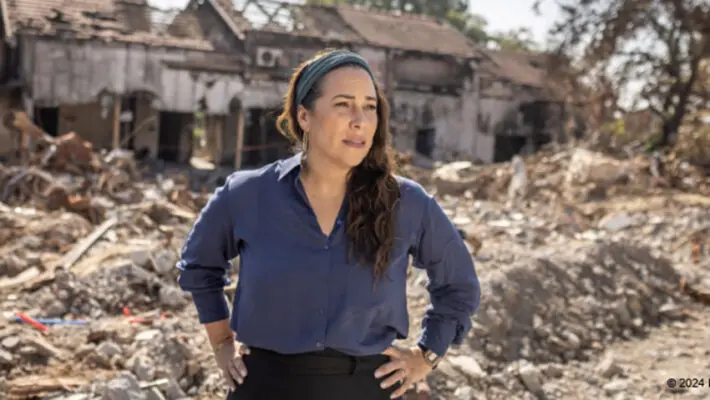
The Fellowship had just installed a reinforced shelter in the Israeli city when sirens warned of incoming Iranian missiles in March 2026. Residents nearby rushed inside, using the shelter almost as soon as the work was complete.
By then, Yael Eckstein and her team had spent more than two years responding to attacks, evacuations and humanitarian needs across Israel. Since Oct. 7, 2023, IFCJ has installed more than 320 mobile bomb shelters in northern Israel, and prepared 1,500 food-purchase cards for families whose homes were damaged or who had been evacuated.
Under Eckstein’s leadership, IFCJ has mobilized a worldwide network of Christian Zionists and other supporters to stand with Israel during its most difficult moments, helping provide shelters, hospital equipment, first-responder gear and direct assistance to Israelis affected by war.
Turning Faith Into Action During Israel’s Darkest Hour
Eckstein was in synagogue when the Hamas attacks started in Oct. 2023. For the first time, she feared that Israel and her own family could be facing a future she had once considered impossible, and the thought that her children could be kidnapped no longer felt like a distant nightmare.
When she returned home, Eckstein told her husband that she was reporting for reserve duty. Her role would not be on the front lines. It would be to use the position she already held.
By half past noon, she had gathered her team and started planning a fundraising response for Israeli civilians. Staff members wanted to know what the organization could do and how much it could spend.
Eckstein told them not to limit the response to a fixed budget. She wanted IFCJ to continue doing everything in its power to help civilians.
That choice stemmed from the Hebrew word Hineni, meaning “Here I am.” To Eckstein, the word represents a willingness to accept responsibility and do difficult work when called.
Over the next two years, IFCJ committed $300 million in aid to Israel to support ongoing emergency needs and continued assistance in its core program areas.. Much of that support came from Christian Zionists around the world who responded almost immediately.
Since Oct. 7, IFCJ has committed $300 million in humanitarian and security aid across Israel. Eckstein also reported that the organization contributed more than 1 billion shekels to programs serving Israeli civilians during that period.
Rapid Relief for Families Under Attack
During crises, Eckstein’s husband takes primary responsibility for their children. She spends her time in affected communities and at the office, where she may sleep for a short period before returning to work.
When attacks from Iran escalated in March 2026, she helped IFCJ expand its emergency response and start coordinating with municipalities, hospitals, rescue teams and aid groups. The organization prepared 13 mobile shelters, including five reinforced Arbel units, and planned to purchase dozens more.
It also worked with the Tel Aviv-Yafo Municipality to place beds in shelters for older residents and prepared evacuation vehicles for older adults and people with disabilities.
IFCJ offered support for a protected underground facility at Rambam Medical Center, which it had helped establish. At Galilee Medical Center, it prepared 300 beds in a protected area and donated a mobile X-ray machine.
Local authorities were set to receive 390 first-aid kits, while United Hatzalah volunteers were set to receive 1,000 bulletproof vests and helmets.
Outside of the hospitals, IFCJ and the ESHEL Chabad Food Bank prepared thousands of food packages. Another 1,686 emergency purchase cards were reserved for people whose homes had been damaged or who had been evacuated.
On March 17, 2026, 100 families from Beit Shemesh received cards worth 1,000 shekels each, or about $322. The families had been displaced after an Iranian missile struck the city and killed nine people. With the cards in hand, they could purchase clothing and other necessities.
These efforts were part of an initial allocation for relief and civil defense during the current war. The funding also supported meals for Holocaust survivors, shelter accommodations, first-responder equipment, hospital needs and help for immigrants.
Building Resilience One Community at a Time
Over the previous two years, the number of people in need of support had grown significantly. Those receiving assistance included evacuees, soldiers, people coping with physical and emotional injuries, former hostages, the families of hostages, bereaved families and new immigrants.
To Eckstein, aid is an ongoing responsibility to people, families and communities, not a short-term reaction to a single event.
Near the Gaza border, IFCJ helped establish, renovate and equip six resilience centers. It also restored kindergartens and public buildings and supported programs for children, teenagers and senior citizens.
In northern Israel, returning families received grants and food vouchers. IFCJ renovated senior clubs, purchased transportation vehicles and supported treatment centers in Katzrin and the western Galilee.
For Yael Eckstein, rebuilding walls addresses only one part of the damage. Families also need a renewed sense of home and places where they can receive emotional support.
The organization became a partner in a treatment center at Sheba Medical Center for former hostages and their families. It also worked with the IDF Disabled Veterans Organization to establish a new Beit Halochem center in Ashdod.
IFCJ assisted thousands of farmers whose fields and incomes had been damaged and created a fund for businesses operated by bereaved families and families of hostages.
In Eckstein’s view, economic stability is critical to recovery because families cannot rebuild a stable life without a dependable way to support themselves.
Building Bridges That Save Lives
Rabbi Yechiel Eckstein founded the International Fellowship of Christians and Jews in 1983 to build lasting relationships between Christians and Jews. Over four decades later, that vision has grown into the world’s largest organization of Christians supporting Israel through humanitarian aid, emergency relief and security assistance.
After Rabbi Eckstein died, his daughter became the organization’s leader and continued that work.
In recent years, The Fellowship has received more than $303 million in donations annually, mostly from Christians, and more than $4.4 billion since its founding. Since its founding, 3.1 million people in the U.S. and around the world have supported Israel and the Jewish people through The Fellowship.
Following Oct. 7, Christian donors gave whatever they could, including many smaller gifts of $25, to support IFCJ’s emergency response.
As organized efforts tried to persuade evangelical Christians not to support Israel, Yael Eckstein chose not to focus on changing the minds of opponents. Instead, she focused on equipping existing supporters with accurate information about what was happening in Israel.
As the war continued, IFCJ brought evangelical leaders, podcasters, news hosts and online influencers to the country so they could see the situation up close and speak about it with their own audiences.
The Flags of Fellowship campaign gave churches and community groups another way to show their support. IFCJ originally hoped 50 churches and universities would display Israeli flags by the anniversary of Oct. 7, but more than 250 churches and community centers across the United States requested to participate.
A year later, the effort had expanded to 1,300 locations. Around 1 million people took part as more than 1.6 million Israeli flags were raised at the same time. When one community leader reported that the flags had been stolen, IFCJ sent replacements.
Eckstein described the campaign as a way to show that public support for Israel remained strong despite hostility toward the country, reminding the world that love is stronger than hate.
Keeping Aliyah Alive Under Missile Fire
Support from millions of Christian Zionists has also allowed IFCJ to continue helping Jewish families make aliyah during wartime.
During Operation Roaring Lion, a special flight carrying more than 50 new immigrants from France and Britain landed at Ben Gurion Airport while missiles were being fired from Iran and Lebanon. IFCJ, the Aliyah and Integration Ministry, and the Jewish Agency organized the flight together.
More than 20 young families and 11 people arriving without relatives were on board. The passengers included four babies, with the youngest only 5 months old, and a 92-year-old immigrant.
Staff completed the absorption process on the plane so that passengers could receive Israeli identification cards and immigrant certificates by the time they landed.
According to the Aliyah and Integration Ministry and the Jewish Agency, more than 60,000 people have made aliyah since Oct. 7. Another 1,000 had recently opened immigration files in spite of the continuing attacks.
Since its founding, The Fellowship has helped more than 780,000 Jews make aliyah from 50 different countries. .
From a newly installed shelter in Holon to a plane arriving during missile fire, IFCJ’s efforts have taken different forms during wartime. Behind each response is the same partnership Rabbi Yechiel Eckstein envisioned decades ago and that Yael Eckstein now leads: a global network of Christian Zionists and other supporters standing with Israel through every difficult season.