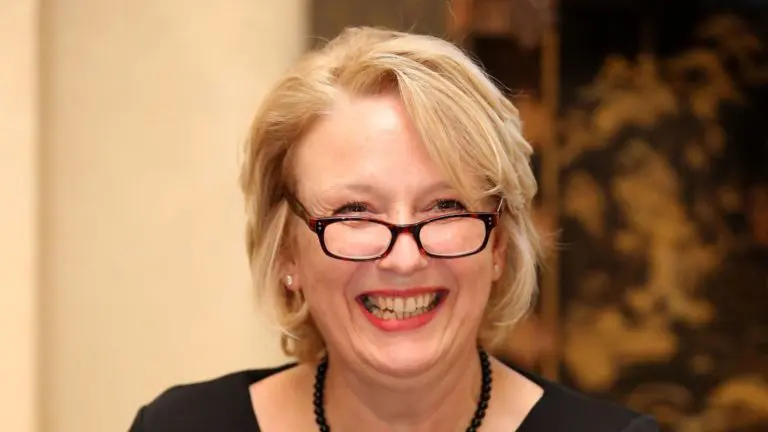


The appointment comes just over six months after Not On The High Street was bought by Executive Equity Partners (EEP), a German investor based in Munich. EEP styles itself as a specialist in “companies facing transformation and challenges that current shareholders can no longer manage alone”.
Davies, who appeared on the BBC business series Dragons’ Den between 2019 and 2025, will mentor the small business owners who sell their goods on the platform, as well as advising on the company’s strategy more broadly.
“We’ve got to drive this forward,” she said. “There is a real sentiment and movement among consumers at the moment of people wanting to buy local. They want to support small businesses. They want to support cottage industries and they want to buy personalised gifts.”
She said she had made a board seat and an equity stake a condition of getting involved. “I said I would only get involved if I’m sitting on the board; if I’ve got a voice, not only at the top table, but in the firm, and I’m an owner in this business. [Mentoring] absolutely plays into the commercial aspirations of the business, because… if we make these people more successful, the whole company grows.”
Davies made her name as the founder of Crafter’s Companion, which she started as a university student in 2005. She was awarded an MBE for services to the economy in 2016 and, in 2019, became the youngest ever female investor to join Dragons’ Den.
Transaction values have more than halved
Founded in 2006 by Sophie Cornish and Holly Tucker, Not On The High Street is widely considered to have pioneered the online marketplace model in Britain by allowing small businesses and creatives to sell their wares widely. Legions of shoppers locked at home during the pandemic spent millions of pounds on personalised gifts and trinkets made by independent creators across the country.
After that boom, however, the company suffered years of declining sales under its former owners Great Hill Partners, an American investment fund.
Accounts filed at Companies House show the total value of transactions on the platform has more than halved since the end of the pandemic, dropping from £185 million in 2022 to £84 million in the year to 31 March 2025. It is understood that total transaction value has since fallen to £72 million.
Alongside shaky consumer confidence and softer retail spending, the business has faced stiff competition from larger rivals, including huge Chinese online marketplaces such as Temu, which sell cheaper, mass-produced goods. It has been forced to shed dozens of jobs in recent years, cutting 70 staff in 2024 and a further 25 in 2025, accounts show.
Purge of drop-shipped listings
Pascal Schuster, who became chief executive when the deal completed in January, said the company had been trying to fight the wrong battle.
“I think what Not On The High Street has historically tried to do is compete with Alibaba, Temu, all of these very cheap gifting moments,” he said. “What we’re trying to do is come back to a real Not On The High Street as it should be. What we’ve been doing… is restructuring the company, rebuilding most of the infrastructure. We feel confident now that at the beginning of next year we will be in a position to grow again.”
As part of the turnaround, Schuster said Not On The High Street had embarked on a purge of products sold via drop-shipping, where sellers import cheap products into Britain without owning any stock themselves, as well as AI-generated product listings.
“We’ve had a very, very hard look at a product catalogue. And we have cleared it of everything that is even remotely in doubt of being drop-shipped without being at least personalised in the UK,” he said. “We don’t want to compete with Shein and Temu. It’s not where we should be.”
He added that he expected total transactions to be flat for the current financial year.
Plans for young entrepreneurs
Davies and Schuster also plan to launch an initiative designed to tackle burgeoning youth unemployment by providing training and development opportunities for young entrepreneurs.
Official figures underline the scale of the problem. An estimated 1,012,000 young people aged 16 to 24 in the UK were not in education, employment or training in the first three months of 2026, according to the Office for National Statistics, a rate of 13.5 per cent and an increase of 89,000 on the same period a year earlier.

Amy Ingham
Amy Ingham is a reporter at Business Matters, covering UK business news with a focus on breaking news, business policy, late payments and insolvency. She joined the magazine in 2026 after completing the NCTJ Diploma in Journalism at Harlow College's journalism school. Her recent reporting includes British Steel's nationalisation and its impact on SME suppliers, the decline in late payments by large firms, and Insolvency Service director disqualifications. Reach her at aingham@cbmeg.co.uk.