

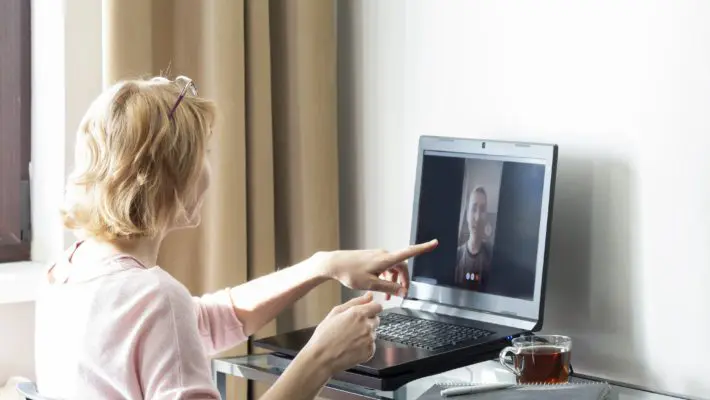
But do you ever notice how exhausted you feel when you get off video chat? Is putting up with screen freezes, accidental microphone incidents, and strange background noises that tiring?
How does it differ from face-to-face communication?
It is thought that using video calling apps requires much more focus than face-to-face conversations. Our brains must work harder to process non-verbal behaviour such as facial expressions, body language and voice intonation. This consumes more of our energy. Partnered with the fact that although mentally and emotionally we are engaging with others, our bodies are not, and our minds can’t trick out bodies into feeling this way. This creates conflicting feelings which can be exhausting for us to experience.
The technology behind it also comes into play. For example, silences in face-to-face contact provide a natural flow for organic conversation. However when this happens over online conversations, we worry that there might be issues with the technology. To avoid talking over the top of somebody, we often wait longer once they’ve fallen quiet, before we begin to speak which also creates lengthy, sometimes uncomfortable pauses.
Finally, there’s the visual element. Although we are physically present in natural conversations, when we’re on camera, we’re very aware of having an audience- even if it is only one person. You know that everybody’s looking at you. Many people feel as if they are performing which creates an even more anxious and stressful experience. I’ve had video chats with people who say they struggle not to look at their own face when they see it on the screen. Most of us will definitely become more aware of our behaviour.
Has the pandemic affected this?
The short answer is yes. Of course, the use of video calling apps bring more stressors than face-to-face conversations, however if you’re feeling exhausted after them, there are probably other factors at play.
Many people may be experiencing stress and anxiety as a result of the lockdown. Video calls can become a constant reminder of your life pre-pandemic. Of course, there is much sadness and upset in the news right now, but that shouldn’t undermine the things you’ve lost that were important to you. Simple things like seeing your colleague come into work or having a chat in the break room. Each time you come into contact with that person on Skype or Zoom, it’s a reminder of what things were like before. This can cause distress for many as we’re again, forced to face the disruption that has affected our daily lives.
It’s also important to consider that due to the pandemic, every aspect of our lives takes place in the same space. Work, friends, family. Our old lives were filled with variety. A variety of people and a variety of places. Our days now are almost identical. We might struggle to switch off from work and fully engage with our family and friends when they call, leaving us vulnerable to negative emotions. We’re confined to one space with only a computer screen available for interaction. There’s also the fact that our downtime might suffer as a result of work and family commitments as well as the time spent worrying over our health and our economy. This can be another factor adding to our exhaustion.
But what about fun video calls?
I know many people are interacting with groups of friends and family members through virtual dinners, catch-ups or birthday parties. These are events that should cause a lot of joy. But we’re still feeling tired. This might be to do with the feelings of obligation. Even if it’s something you want to do, and you enjoy at the time, the likelihood is that you’ve had to schedule it ahead of time and planned for whatever activity is taking place.
This increases the amount of time you feel switched on, increasing feelings of fatigue. It’s important then to engage in video calls where you feel you can completely be yourself. You don’t have to put an act on, or ‘perform’ as it is. The experience will feel more natural and joyful.
You should also be aware of the fact that the tools we are using for video chats are ones that we’ve come to associate with work. You’ve probably never relied on Skype and Zoom in your personal life. You might not even be conscious of this, but the likelihood is that your brain has developed a connection between these tools and work which might explain why you feel tired even logging in.
How do I fix the problem?
- Limit video calls to those that are necessary. Only use the camera if you feel comfortable to do so. Eliminating an audience can cause people to feel more relaxed. There should be an understanding with the group that cameras do not always have to be on if they don’t need to be.
- If your camera is on, try adjusting the camera angle so that your screen is off to your side. This can create the feeling of an adjoining room as opposed to staring at someone straight on which can be quite unnatural in a working environment.
- Consider using other tools that might be more efficient for work such as shared files in Google Drive. Documents can be edited, viewed and commented on by others in the group, and can avoid information overload.
- Dedicate time to small talk. Now that we’re doing business on screens, many of us get straight into the meeting. You should make time at the start of meetings to engage in chit chat with your colleagues and have general catchups that aren’t always centred around work. This can help to feel reconnected as a team again and reduce fatigue.
- Include transition periods between meetings. These can help employees to feel refreshed. Encourage exercise or going off to have a drink. Even stepping outside for some fresh air. It’s vital to set boundaries and create buffers between our professional identities and our personal ones.
- If we’re talking about personal video calls, maybe consider using an alternate method. It would be difficult to substitute large group chats, but in the case of a one-on-one conversation, try writing a letter which allows you to be completely away from your screen. Writing is thought to make us feel more relaxed when it involves the physical act of putting pen to paper. It’s also a very touching thing to receive as you appreciate the time and care it takes to do it.
Although lockdown might be easing off, we are still not able to meet up with loved ones and probably won’t be for the near future. Our reliance on apps such as Skype and Zoom will continue so I hope these tips are useful for staying connected with friends, colleagues and relatives throughout this difficult time.
I am still offering walk-and-talk sessions which can take place over the phone or via Skype or Zoom. Our conversation will allow you to talk through the challenges you’re facing professionally and personally. I am here to listen to what you’re going through and provide confidential help and support.
Continue to look after yourselves and to look after those around you.

Carole Spiers
Carole is the CEO of a leading UK stress management and wellbeing consultancy. She is a BBC Guest-broadcaster and author of Show Stress Who’s Boss! Carole is an international Motivational Speaker and is regularly called upon by the national press and media for comment. She is Chair of the International Stress Management Association [UK], founder of Stress Awareness Day, Fellow and Past President of the Professional Speaking Association, London. www.carolespiers.co.uk