

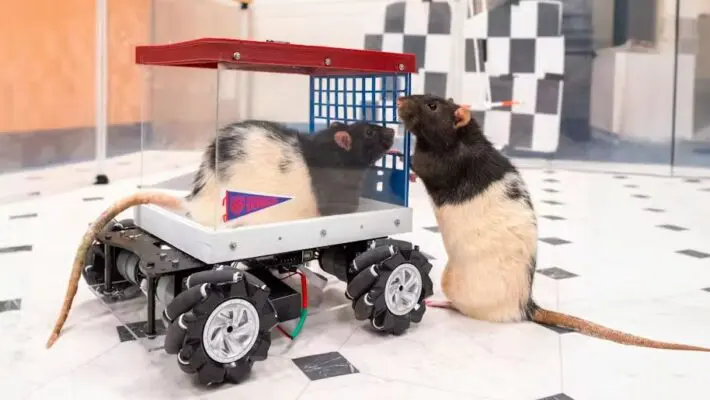
The study, led by Professor Kelly Lambert, found that not only can rats learn to operate tiny vehicles, but they also exhibit signs of excitement and anticipation when given the opportunity to drive.
In the initial 2019 study, rats were taught to steer a car made from a plastic cereal container by grasping wires that propelled the vehicle forward. The rodents quickly mastered the skill, steering with surprising precision to reach a piece of Froot Loop cereal as a reward.
Building on these findings, the researchers developed improved “rat-operated vehicles” equipped with rat-proof wiring, durable tires, and ergonomic driving levers. They observed that the rats showed intense motivation during training sessions, often jumping into the car and initiating the driving mechanism before the vehicle began moving.
Professor Lambert noted that the driving-trained rats eagerly approached the side of their cage during testing times, similar to how a dog might react when anticipating a walk. This behavior led the team to question whether the rats were motivated solely by the food reward or if they found the driving experience itself rewarding.
To investigate further, the researchers offered the rats a choice: they could either take a short, direct path on foot to obtain the treat or drive the car on a longer route, delaying their reward. Surprisingly, two out of the three rats chose to drive, suggesting they derived pleasure from both the journey and the destination.
Physical signs of positive anticipation were also observed. One rat held its tail upright with a crook at the end, resembling an old-fashioned umbrella handle—a posture linked to the release of dopamine, a neurotransmitter associated with motivation and reward.
Professor Lambert concluded that these findings highlight the importance of stimulating environments and novel experiences for cognitive development. “Anticipating positive experiences helps drive a persistence to keep searching for life’s rewards,” she said. “Planning, anticipating, and enjoying the ride may be key to a healthy brain.”

Jamie Young
Jamie Young is Senior Reporter at Business Matters, covering SME finance, employment law and Westminster policy since 2016. He has reported on every Budget and Autumn Statement since 2018, helped make sense of the 'covid era' and the bounce-back loan scheme from launch through the fraud investigations, and broke the magazine's coverage of the 2024 late-payment reforms. He joined Business Matters straight from completing his BA in Administration from Exeter University and is NCTJ-qualified. Reach him at jyoung@cbmeg.co.uk