

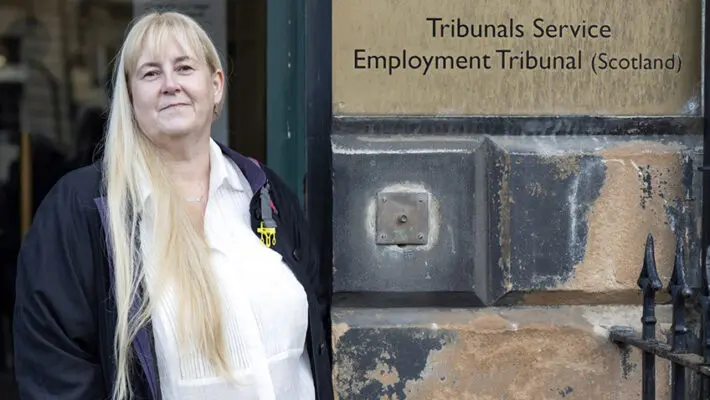
Maria Kelly, a people and capability lead at the defence giant, claimed she experienced harassment, direct sex discrimination and indirect sex discrimination after the company allowed transgender women to use female toilets. Her grievance centred on an incident in March 2023, when she said she encountered a transgender colleague in a women’s bathroom. She told the tribunal she subsequently began using a “secret” toilet due to discomfort and concerns over privacy.
The claims were dismissed in full by employment judge Michelle Sutherland in a written judgment published on Wednesday following a hearing in Edinburgh in October.
Leonardo UK employs around 9,500 people. Judge Sutherland noted that Kelly was the only employee to raise concerns about the policy, despite multiple channels being available to do so.
She found that Kelly had not been put at a legal disadvantage, writing: “Any fear or privacy impact could be addressed by affected female staff making recourse to the single-occupancy facilities.”
The tribunal also rejected arguments that safety risks increased, ruling that the possibility of 0.5% of male staff using the women’s toilets “would not have changed the overall risk profile”.
The judgment concluded that Leonardo’s toilet access policy was “a proportionate means of achieving a legitimate aim”.
The ruling comes in the wake of the UK Supreme Court’s decision in April, which held that “woman” and “sex” in the Equality Act 2010 refer to biological sex — a landmark judgment invoked heavily by Kelly’s legal team.
Kelly said the tribunal “fundamentally misunderstands both the law and my case”, adding she intends to appeal urgently to the Employment Appeal Tribunal.
Sex Matters chief executive Maya Forstater claimed the judgment was “incompatible” with the Supreme Court’s ruling in For Women Scotland, criticising what she called the tribunal’s “gender identity–based” interpretation.
Leonardo UK acknowledged the tribunal outcome, saying in a statement: “Our focus now is to ensure workplace conduct remains respectful and our facilities’ policies continue to meet legal standards. We will review forthcoming Equality and Human Rights Commission guidance when published.”
Employment lawyer Hina Belitz of Excello Law said the ruling illustrates the “complicated picture” facing courts and employers following the Supreme Court’s clarification of biological sex in equality law.
“This is particularly the case when determining whether individuals have rights to protected single-sex spaces,” she said.

Amy Ingham
Amy Ingham is a reporter at Business Matters, covering UK business news with a focus on breaking news, business policy, late payments and insolvency. She joined the magazine in 2026 after completing the NCTJ Diploma in Journalism at Harlow College's journalism school. Her recent reporting includes British Steel's nationalisation and its impact on SME suppliers, the decline in late payments by large firms, and Insolvency Service director disqualifications. Reach her at aingham@cbmeg.co.uk.