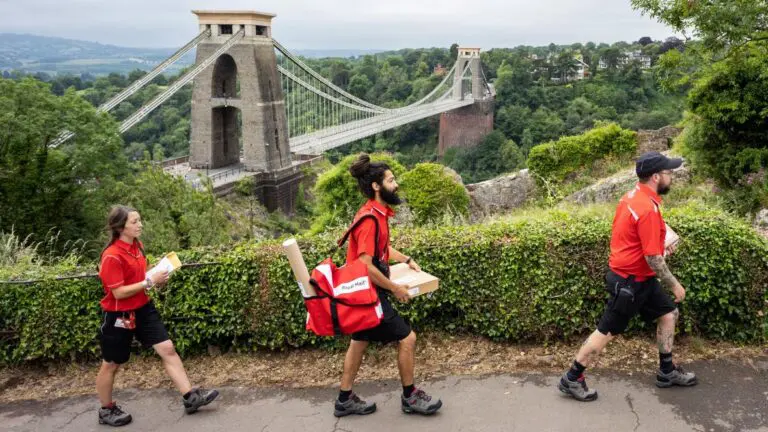
A golf course owned by the John Lewis Partnership for almost a century has been put up for sale as the department store owner seeks to cut costs and after failing to attract staff onto the links.
Category: News
The latest news affecting small and medium sized (SME) businesses in the UK
High Street chain closures slow with takeaways thriving
Chain stores are closing at their slowest rate for eight years, new research shows.
Sainsbury’s to close two Argos distribution sites risking 1,400 jobs
Sainsbury’s is planning to close two Argos distribution centres, putting up to 1,400 jobs at risk, and will ditch the catalogue shop’s Milton Keynes head office and three remaining Habitat showrooms to cut costs.
UK facing double blow on inflation
Grocery prices inflation reached a high of 17.1 per cent last month, with the fastest rises recorded in essentials such as milk, eggs and margarine.
Fintech ‘innovation hubs’ set to launch around the UK in levelling up push
A host of “innovation hubs” are set to be launched in cities across the UK today as part of a Treasury-backed plans to boost the growth of fintech beyond London.
Amazon workers ready for ‘David and Goliath battle’ against employer over poor pay conditions
Amazon workers have said that they are ready for a “David and Goliath battle” as they begin their second round of strikes this year over poor pay and working conditions.
Parents forced to stay at home as thousands of teachers start three days of ‘unforgivable’ strikes
Tens of thousands of teachers across England and Wales will strike over three days this week in the long-running dispute over pay. Teachers will walk out across the north of England on Tuesday with the majority of schools expected to either restrict access to some pupils or fully close, the National Education Union (NEU) has […]
Women in board roles at UK’s biggest listed firms above 40% for first time
The proportion of women in board roles in Britain’s biggest listed companies has risen above 40% for the first time, according to analysis that suggests only 10 of the UK’s 350 largest listed companies still have all-male executive teams.
Poor outlook for growth could limit scope for budget tax cuts
A £30 billion boost to the government’s finances is likely to be wiped out by a downgrade in forecasts for economic growth at next month’s budget, a think tank has warned.
Book Bodega of Ramsgate turns new page with Twitter SOS
Independent bookshops are a cornerstone of many high streets, offering cosy reading nooks and personalised recommendations to those willing to venture into town for their next paperback.
Small business champion Good Business Pays appoints former Small Business Commissioner, Philip King, Non-Executive Director
Good Business Pays today announced the appointment of Philip King as Non-Executive Director.
CBI urges Jeremy Hunt to rethink tax grab at March budget
British businesses are poised to mothball investment due to uncertainty over whether the country is on course to tip into a recession and a looming tax grab, a new survey out today indicates.
Australian startup Recharge finalises deal to take over UK battery maker Britishvolt
The Australia-based company Recharge Industries will take over collapsed battery maker Britishvolt after finalising a deal with administrators late on Sunday in the UK.
Ofgem cuts energy price cap but bills are still set to rise
The energy regulator has cut its price cap by £999 but households are still expected to see a rise of up to £500 in their bills from April.
Jeremy Hunt handed £24bn spending boost before budget
Government departments are due to spend £24 billion less than the Treasury budgeted for last October, new figures show, increasing pressure on Jeremy Hunt before next month’s budget.


![Jeremy Hunt hit the TV and radio studios yesterday like a whirlwind. Hours into his new job as chancellor, his task was to calm the financial markets, which had so brutally moved against his predecessor and triggered surging borrowing costs for homeowners. But has he done enough? Can his words calm turbulent gilt yields when trading opens on Monday morning? The risk is that markets will be hugely volatile on what will be the first time in two weeks that the Bank of England is not standing behind gilts, or government bonds, ready to buy them to ease pressure on pension funds. IN YOUR INBOX Business briefing In-depth analysis and comment on the latest financial and economic news from our award-winning Business teams. Sign up now Hunt’s media appearances were seen as an attempt to address the problems Kwarteng had created with the unfunded tax cuts in his mini budget. Acknowledging that mortgage rates have already rocketed — to as high as 7 per cent, according to some estimates — Hunt pledged credible tax and spending policies. “No chancellor can control the markets or should ever seek to do so. But the thing that is within your power is to demonstrate certainty in public finances,” he told the BBC. ADVERTISEMENT Rupert Harrison, an adviser to George Osborne when he was chancellor and now at BlackRock, said Hunt’s comments were a “turning point”. “Markets now have someone in the Treasury who gets it and who they can trust,” he said. There has been an unprecedented sell-off of gilts in the past two weeks amid fears that the tax cuts proposed by Kwarteng would fuel inflation and force the Bank of England to raise interest rates. Markets are pricing in a rise of a full percentage point from the Bank next month to take the base rate to 3.25 per cent. Even after Kwarteng’s replacement by Hunt on Friday afternoon, bond markets kept selling. Some analysts have suggested they will keep attacking until Truss resigns. Economist Julian Jessop, who has been advising the Truss camp, said Hunt’s pledge of fiscal discipline meant “Trussonomics” had been junked. SPONSORED “The whole point about Trussonomics was growing the economy ... not about a combination of tax cuts and big cuts in spending [the traditional approach]”. Jessop has previously said that Kwarteng’s mini budget went too far in announcing tax cuts, as this had spooked the markets. Hunt attempted to show yesterday that he would start work on plans to balance the books ahead of the budget planned for October 31. Unlike with the mini budget, the Office for Budget Responsibility will publish economic forecasts to accompany the government’s fiscal plans. He acknowledged to the BBC that two mistakes had been made by Kwarteng: abolishing the 45 per cent top rate of income tax; and the decision to “fly blind” without the OBR forecasts. On Friday, Truss also ditched plans to reverse a rise in corporation tax from 19 per cent to 25 per cent. That will raise £18 billion. ADVERTISEMENT Hunt also warned about “difficult decisions” on spending and taxes. “We’re going to ask all government departments to find efficiencies,” he said. “But we’re also going to have pressure on the tax side — taxes are not going to come down by as much as people hoped, and some taxes will have to go up.” George Buckley, economist at Nomura, said more detail was still needed. The reversal of the corporation tax move, he argued , “goes only a portion of the way”. Business leaders, as well as the financial markets, were watching Hunt’s performances closely. Dominic Blakemore, chief executive of FTSE 100 catering giant Compass, said the events of the past few days had been “pretty shocking”. “Throughout, we’ve needed robust, fully costed plans, because markets just can’t operate without that and in a vacuum,” he explained. Phil Urban, chief executive of FTSE 250 pub chain Mitchells & Butlers, called the situation “ shambolic”. “Business is probably realising that it can’t rely on government or politics to sort things out. So we’re just focusing on what is in our gift to do,” said Urban. One FTSE 100 boss, who did not want to be identified, resorted to expletives to describe his frustration. Describing Truss and Kwarteng as “goons”, he added: “Every single household is spending most of their time trying to balance their books, and our f***ing prime minister and chancellor don’t have to? Are you f***ing taking the piss?” His view was that Truss also had to go, to restore credibility. And that may be what the markets start to demand when trading resumes on Monday. ADVERTISEMENT Jessop said: “I don’t think Hunt did anything that would upset the markets or surprise them. But markets don’t like uncertainty. Uncertainty about economic policy — that’s maybe eased a little bit. But now we’ve got an increase in political uncertainty as we can’t be sure who the prime minister is going to be next weekend.”](https://b3935509.assetcdn.net/2.0/3935509/wp-content/uploads/2022/10/Jeremy-Hunt-230x129.jpg?lossy=2&strip=1&webp=1)