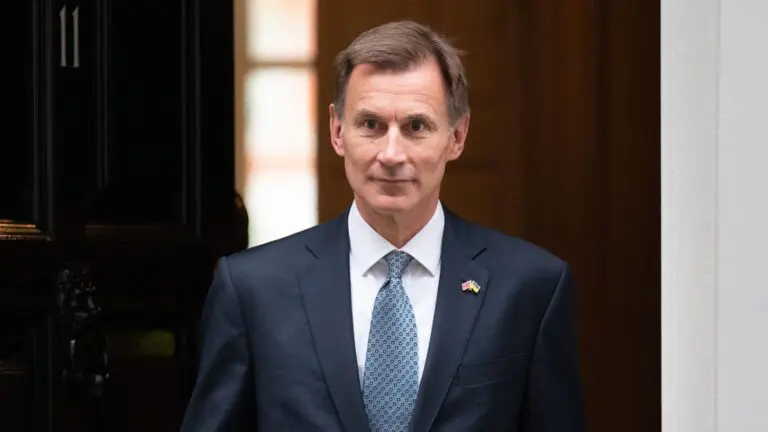
Jeremy Hunt has said he wants “those who have more to contribute more” as he unveils plans for all Britons to pay more tax.
Category: News
The latest news affecting small and medium sized (SME) businesses in the UK
Neighbours is saved with Iconic soap to return on Amazon Freevee months after final episode aired
Neighbours has been saved – just four months after its final episode aired, proving to be a ratings hit in both the UK and Australia.
Losses balloon for Royal Mail as strike action continues to take its toll
Royal Mail confirmed plans to cut 10,000 jobs by next year as losses continue to widen as a result of ongoing strike action and inflationary pressure.
Jeremy Hunt to announce largest tax rises in a decade targeting wealthy with stealth taxes
Jeremy Hunt will announce today the biggest package of tax rises and spending cuts for more than a decade.
Labour seeks to protect face-to-face banking by forcing Commons vote
Labour is planning to force a vote on guaranteeing in-person banking across the country, following swathes of branch closures that have left local communities without face-to-face services.
Musk gives Twitter staff deadline to commit to long hours and being ‘hardcore’
Elon Musk has given Twitter’s remaining staff a Thursday deadline to commit to working “long hours at high intensity” and being “extremely hardcore” or else leave with three months’ severance pay.
Thierry Bolloré steps down as CEO of UK’s largest automotive employer Jaguar Land Rover
Thierry Bolloré has resigned as chief executive of Jaguar Land Rover (JLR) after two years in the job, citing “personal reasons”, in a surprise move that prompted questions over the strategy of the UK’s largest automotive employer.
British government blocks takeover of Welsh semiconductor producer
The British government has blocked the takeover of the UK’s largest producer of semiconductors by a Chinese-owned manufacturer, citing “a risk to national security”.
Google to pay record £330m privacy settlement
Google will pay $391.5m (£330m) to settle allegations about how it collects data from users.
Gupta’s UK steel business strikes nears deal with creditors to stave off bankruptcy
The UK arm of Sanjeev Gupta’s steel empire has struck a preliminary deal with major creditors that could let it stave off insolvency proceedings by restructuring its debts.
Moët hails new ‘roaring 20s’ as wealthy drain stocks of champagne
The company behind Moët & Chandon, Veuve Clicquot, Krug and Dom Pérignon has said it is “running out of stock on our best champagnes” as the wealthy spend big on luxury goods in a new “roaring 20s” age of decadence.
Higher costs trigger rise in insolvencies
Company insolvencies rose sharply last month as businesses were faced with higher inflation and an uptick in winding-up petitions from HM Revenue & Customs.
Pound hits three-month high against dollar as US inflation cools
The pound rose above $1.20 for the first time in almost three months yesterday as expectations grow that inflation in the US has peaked.
Europe set for diesel supply scramble as tight marketshare exposed
Europe could be scrambling for diesel supplies over the winter, with the continent increasingly exposed to “exceptionally tight markets,” warned the International Energy Agency (IEA).
Brexit a major cause of UK’s return to austerity, says senior economist
Brexit is the ultimate reason why the UK now faces a fresh round of austerity, a former interest rate-setter at the Bank of England has said.


![Jeremy Hunt hit the TV and radio studios yesterday like a whirlwind. Hours into his new job as chancellor, his task was to calm the financial markets, which had so brutally moved against his predecessor and triggered surging borrowing costs for homeowners. But has he done enough? Can his words calm turbulent gilt yields when trading opens on Monday morning? The risk is that markets will be hugely volatile on what will be the first time in two weeks that the Bank of England is not standing behind gilts, or government bonds, ready to buy them to ease pressure on pension funds. IN YOUR INBOX Business briefing In-depth analysis and comment on the latest financial and economic news from our award-winning Business teams. Sign up now Hunt’s media appearances were seen as an attempt to address the problems Kwarteng had created with the unfunded tax cuts in his mini budget. Acknowledging that mortgage rates have already rocketed — to as high as 7 per cent, according to some estimates — Hunt pledged credible tax and spending policies. “No chancellor can control the markets or should ever seek to do so. But the thing that is within your power is to demonstrate certainty in public finances,” he told the BBC. ADVERTISEMENT Rupert Harrison, an adviser to George Osborne when he was chancellor and now at BlackRock, said Hunt’s comments were a “turning point”. “Markets now have someone in the Treasury who gets it and who they can trust,” he said. There has been an unprecedented sell-off of gilts in the past two weeks amid fears that the tax cuts proposed by Kwarteng would fuel inflation and force the Bank of England to raise interest rates. Markets are pricing in a rise of a full percentage point from the Bank next month to take the base rate to 3.25 per cent. Even after Kwarteng’s replacement by Hunt on Friday afternoon, bond markets kept selling. Some analysts have suggested they will keep attacking until Truss resigns. Economist Julian Jessop, who has been advising the Truss camp, said Hunt’s pledge of fiscal discipline meant “Trussonomics” had been junked. SPONSORED “The whole point about Trussonomics was growing the economy ... not about a combination of tax cuts and big cuts in spending [the traditional approach]”. Jessop has previously said that Kwarteng’s mini budget went too far in announcing tax cuts, as this had spooked the markets. Hunt attempted to show yesterday that he would start work on plans to balance the books ahead of the budget planned for October 31. Unlike with the mini budget, the Office for Budget Responsibility will publish economic forecasts to accompany the government’s fiscal plans. He acknowledged to the BBC that two mistakes had been made by Kwarteng: abolishing the 45 per cent top rate of income tax; and the decision to “fly blind” without the OBR forecasts. On Friday, Truss also ditched plans to reverse a rise in corporation tax from 19 per cent to 25 per cent. That will raise £18 billion. ADVERTISEMENT Hunt also warned about “difficult decisions” on spending and taxes. “We’re going to ask all government departments to find efficiencies,” he said. “But we’re also going to have pressure on the tax side — taxes are not going to come down by as much as people hoped, and some taxes will have to go up.” George Buckley, economist at Nomura, said more detail was still needed. The reversal of the corporation tax move, he argued , “goes only a portion of the way”. Business leaders, as well as the financial markets, were watching Hunt’s performances closely. Dominic Blakemore, chief executive of FTSE 100 catering giant Compass, said the events of the past few days had been “pretty shocking”. “Throughout, we’ve needed robust, fully costed plans, because markets just can’t operate without that and in a vacuum,” he explained. Phil Urban, chief executive of FTSE 250 pub chain Mitchells & Butlers, called the situation “ shambolic”. “Business is probably realising that it can’t rely on government or politics to sort things out. So we’re just focusing on what is in our gift to do,” said Urban. One FTSE 100 boss, who did not want to be identified, resorted to expletives to describe his frustration. Describing Truss and Kwarteng as “goons”, he added: “Every single household is spending most of their time trying to balance their books, and our f***ing prime minister and chancellor don’t have to? Are you f***ing taking the piss?” His view was that Truss also had to go, to restore credibility. And that may be what the markets start to demand when trading resumes on Monday. ADVERTISEMENT Jessop said: “I don’t think Hunt did anything that would upset the markets or surprise them. But markets don’t like uncertainty. Uncertainty about economic policy — that’s maybe eased a little bit. But now we’ve got an increase in political uncertainty as we can’t be sure who the prime minister is going to be next weekend.”](https://b3935509.assetcdn.net/2.0/3935509/wp-content/uploads/2022/10/Jeremy-Hunt-230x129.jpg?lossy=2&strip=1&webp=1)