
The round, announced on 8 September, was led by Samsung. PSG Equity, an existing investor, and the European Union’s Scaleup Europe Fund also took part. Mistral said the money would be used to scale its computing capacity and frontier research as it positions itself as an alternative to AI models developed in Silicon Valley and China.
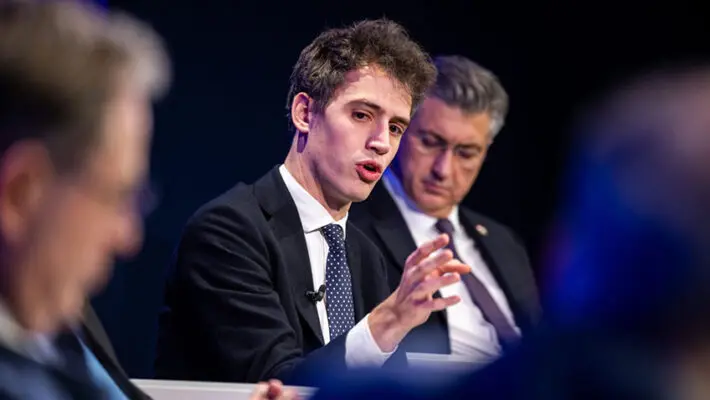
“This round means we can move faster on R&D [research and development], products, infrastructure and keep giving organisations the ability to run AI at scale, on their own terms,” Arthur Mensch, a co-founder and chief executive of Mistral, said.
Founded three years ago, Mistral is one of the few European companies developing its own large language models and has marketed itself as the European alternative to US groups such as OpenAI and Anthropic.
Infrastructure and open-weight models
Over the past year the company has expanded into AI infrastructure, allowing it to run its own models rather than rely on another provider’s computing capacity. In March it raised $830m from a consortium of banks to buy thousands of Nvidia chips to power its data centres in France and Sweden. Nvidia itself agreed a $12.9bn deal to buy Hugging Face, the open AI model platform, on 3 September.
Mistral said it is seeking to build a “vertically integrated” AI offering spanning computing capacity, frontier models and applications.
Unlike its US rivals, many of Mistral’s models are open-weight, meaning customers can fine-tune them and run them on their own hardware. That allows sensitive data to be processed locally rather than over the cloud, a factor for companies in heavily regulated industries. The Cambridge spinout Flower Labs has made a similar case for its Endeavor model, which it says users can deploy on their own IT systems.
Mensch, 34, said open-weight models were increasingly popular with businesses aware of the risks of “surrendering control over the infrastructure”.
He said: “Organisations want to industrialise AI inside systems that are already complex: their own data, their own tools, their own compliance constraints. That’s the real problem. It’s why we’ve built Mistral on open-weight frontier models and infrastructure that we control end to end, so our customers can too.”
In February, Mistral said it was on track to surpass $1bn in annual recurring revenue by the end of the year, after revenue rose twentyfold in 12 months. In its announcement of the round, the company said it now serves more than 125 enterprises across 20 countries. Its customers include several major European governments alongside ASML, a supplier to the semiconductor industry, HSBC and TotalEnergies, the French energy company.
Competition and valuation
Mistral faces increasing competition from Chinese open-weight models. In July, Moonshot, a Chinese AI start-up, said its Kimi K3 model could rival leading US models at lower prices.
A report from Ramp AI, a payments company that tracks spending on AI models, found that spending on open-weight models among American businesses rose to 6.1 per cent of total AI spend in July, up from 4.5 per cent at the start of the year.
The Scaleup Europe Fund, which participated in the round, is a €5bn fund set up by the European Commission to back European companies and prevent them from moving abroad. Launched in August, it is managed by EQT, which the European Innovation Council selected as fund manager following a competitive process.
Mistral’s valuation remains below that of its American rivals. Anthropic is understood to be pursuing a $2trn valuation in an initial public offering expected later this year.
Mensch has previously said that Europe has a two-year window in which to avoid becoming a “vassal state” dependent on US digital infrastructure.

Amy Ingham
Amy Ingham is a reporter at Business Matters, covering UK business news with a focus on breaking news, business policy, late payments and insolvency. She joined the magazine in 2026 after completing the NCTJ Diploma in Journalism at Harlow College's journalism school. Her recent reporting includes British Steel's nationalisation and its impact on SME suppliers, the decline in late payments by large firms, and Insolvency Service director disqualifications. Reach her at aingham@cbmeg.co.uk.