

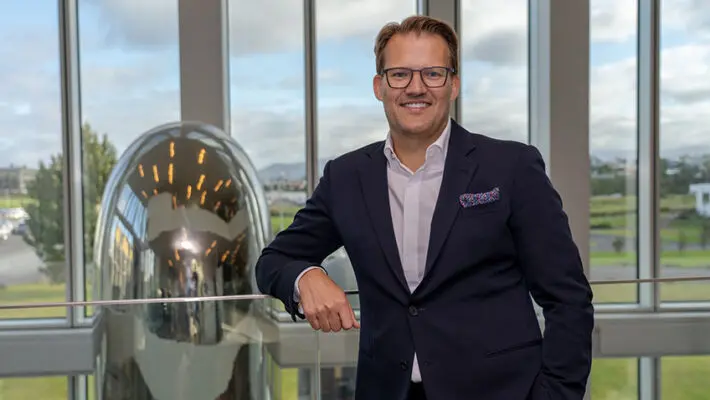
Róbert Wessman, the 56-year-old founder and chief executive of Alvotech and the owner of fast-growing French wine venture Maison Wessman, has told Business Matters in an interview at his Pall Mall club that the “whole package” of inheritance tax, capital gains tax and political instability is steadily pushing him towards the exit.
“It’s just the whole scheme has changed so much, which makes it very difficult, not only for foreigners to come here, but for wealthy people, who live here, are born here, and have always been here, to basically stay here,” Wessman said.
His warning lands as Britain digests the most striking edition of the Sunday Times Rich List in living memory, with one in six members of the 2026 list dropping out and the UK billionaire population falling to 157, twenty fewer than four years ago. Almost a third of the 350 British nationals on the main list no longer live on the British mainland.
‘Not a pro-business country anymore’
Wessman, who moved his family from Reykjavík to London in 2019 and opened a Hammersmith head office for his Aztiq investment vehicle two years later, said he no longer regarded the UK as a pro-business destination.
“At the same time, the stability is not really there. You had Brexit, it was a big issue for the industry, for the country, for the business, and then all the tax legislation now,” he said.
He spoke before the former health secretary Wes Streeting, who has launched a Labour leadership bid against Sir Keir Starmer, pledged what he called a “wealth tax that works”, centred on aligning capital gains rates with income tax. The proposal has been costed by allies at around £12 billion a year.
Asked about politicians’ appetite for taxing the wealthy, Wessman was unsparing: “We see this in many countries, that this can be the flavour of the day for politicians. But in the end, countries are built on employment, on jobs, high-paying jobs preferably, value creation. And hopefully you can then benefit from having the business in the country.”
His comments echo a growing chorus of warnings from international business owners. Henley & Partners has forecast that Britain will lose more millionaires than any country bar China this year, and a BDO survey recently found that two-thirds of the UK’s ultra-wealthy have considered relocating, citing policy inconsistency as a bigger problem than the headline tax rate itself.
From Icelandic generics to Nasdaq biosimilars
Wessman has built, and lost, fortunes before. He turned Delta, an obscure Reykjavík generics business, into Actavis, one of the world’s largest generic drugmakers, before losing an estimated €250 million in the 2008 Icelandic banking crash. That episode triggered a long and bitter legal battle with fellow Icelandic financier Björgólfur Thor Björgólfsson over a highly leveraged pre-crisis buyout.
Undeterred, he has founded seven companies over three decades and is now ploughing capital into Alvotech, the Nasdaq, Icelandic and Swedish-listed group he is positioning as a global challenger in biosimilars.
The group has invested $2 billion since 2013, employs 1,500 staff, most of them in Reykjavík, and is being built deliberately as the “fourth leg” of the Icelandic economy alongside fishing, tourism and manufacturing. Alvotech has five approved biosimilars on the market, generated revenues of $593 million last year and is guiding to $650 million to $700 million in 2026. It is currently valued at around $1 billion in New York.
Wessman holds a 35 per cent stake through Luxembourg-domiciled Aztiq, plus a further 30 per cent through a partnership with Temasek, the Singapore sovereign wealth fund, and private equity house CVC Capital Partners.
Biosimilars, close copies of complex biological drugs whose patents have expired, are notoriously expensive to develop and frequently trigger patent litigation, as Alvotech experienced in its dispute with AbbVie over the autoimmune blockbuster Humira. Wessman argues they are essential if state-funded healthcare systems are to avoid being “sunk” by the cost of modern biologics.
A château, two million bottles and Norah Jones
His diversification into wine began as a hobby with the 2004 acquisition of the 12th-century Château de Saint-Cernin, near Bergerac, and the release of an inaugural vintage in 2016. Maison Wessman is now on track to produce around two million bottles this year, supplying French retailer Intermarché and backed by the American jazz singer Norah Jones, whom Wessman met through a mutual contact after Enrique Iglesias played at his wedding.
‘We are leaving with a lot of capital, a lot of jobs’
Wessman, who is not a non-dom, said he moved to London “against the stream when Brexit was happening” because of the capital’s practical access to his businesses across Asia, the United States and central and eastern Europe. His Russian-born wife and six children are settled in “world-class” London schools.
“London is the most amazing city to live in. It has amazing education. It has everything to offer. It has amazing history,” he said.
But he believes Brexit was a strategic error for what he called “a very proud nation”, leaving Britain less integrated into European supply chains and badly diminished as a listing venue.
“Since Brexit, many of the big banks don’t ever bring up the UK as an alternative, as a listing venue anymore,” he said.
That listings problem now compounds with sweeping fiscal reform. The chancellor, Rachel Reeves, has scrapped the centuries-old non-dom regime and replaced it with a new four-year residence-based test for foreign income and gains, plus a residence-based inheritance tax that captures worldwide assets for those resident in the UK for ten of the previous twenty years. Capital gains tax rates were also lifted in the October 2024 Budget to 18 per cent and 24 per cent.
The early evidence is unflattering: around 1,800 non-doms have already quit the UK in the wake of the reforms, raising serious questions about whether the package will deliver the £34 billion Treasury revenue target.
Wessman said he had recently looked at properties in Milan and made clear he was reluctantly being pushed in that direction.
“I don’t regret paying high taxes in the UK,” he said, “but it has to be within certain certainties and scope. I’m sitting with my tax adviser getting an update two to three times a year of what might be coming next, and it’s all over the place. This is not encouraging anyone to live here.”
“I really love to live here. But overall, I think where you have mobile capital, which can be based anywhere, it will push more people out.
“We are leaving with a lot of capital. We are leaving with a lot of jobs. We are leaving without even thinking that the UK would be a good idea to build any manufacturing or R&D or anything. That’s the sad part of it.”
For a government banking on wealthy non-doms to part-fund public services, that is a warning shot from precisely the sort of internationally mobile, job-creating, IP-rich founder the Treasury insists it still wants to attract.

Amy Ingham
Amy Ingham is a reporter at Business Matters, covering UK business news with a focus on breaking news, business policy, late payments and insolvency. She joined the magazine in 2026 after completing the NCTJ Diploma in Journalism at Harlow College's journalism school. Her recent reporting includes British Steel's nationalisation and its impact on SME suppliers, the decline in late payments by large firms, and Insolvency Service director disqualifications. Reach her at aingham@cbmeg.co.uk.