
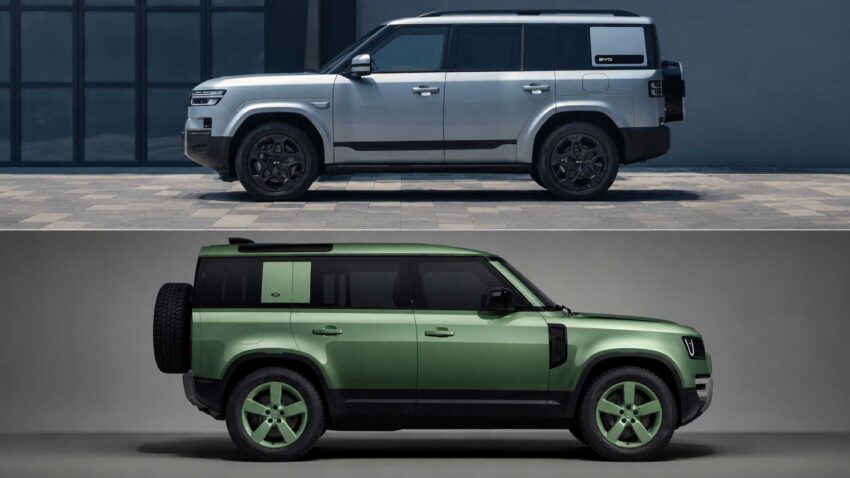
Jaguar Land Rover has orchestrated a raid on the European offices of BYD, the Chinese carmaker, as it builds a case that BYD’s new Ti7 SUV copies the design of its best-selling Defender.
Bailiffs seized digital documents from BYD’s offices in Schiedam and Hoofddorp in the Netherlands in August, according to the Sunday Times. The Ti7 is due to go on sale in the UK in January 2027.
JLR, which is owned by India’s Tata Motors, is challenging BYD over claims that the Ti7’s boxy shape infringes its intellectual property rights. It hopes the seized material will show that BYD intentionally copied the latest generation Defender’s design, rather than simply producing a similarly styled vehicle.
A court is due to decide which of the confiscated records, if any, can be used in the case. The two companies have already faced each other in a courtroom in The Hague. BYD is said to have described the move as a “fishing expedition” as it seeks to rebut the allegations.
A JLR spokesman said the company “does not comment on ongoing legal proceedings”. A BYD representative also declined to comment.
JLR is likely to seek to have the Ti7 blocked from European showrooms, according to the report, though the case is unlikely to be resolved before it reaches Britain.
It is not the first time JLR has gone to law over alleged cloning. In 2020 it failed in an attempt to trademark the shape of the original Defender, a move intended to stop Sir Jim Ratcliffe launching the Ineos Grenadier, his 4×4 inspired by the original Land Rover.
A year earlier, JLR won a case in China against Jiangling Motor Corporation, when a Beijing court ruled that its Landwind X7 had copied five unique features of the Range Rover Evoque.
The Ti7 is a seven-seat plug-in hybrid which, BYD says, can cover 102 miles in electric-only mode. In size it sits between the five-seat Defender 110 and the seven-seat Defender 130. BYD’s website says its “unapologetically boxy profile delivers the imposing, chunky design that finds favour among SUV buyers, yet delivers a contemporary look”.
Prices start at £47,995. That is about £21,000 less than the cheapest Defender 110 fitted with optional seven seats, and about £35,000 less than the seven-seat Defender 130.
The Defender is JLR’s best-selling model, with more than 115,000 orders last year, around three in 10 of the company’s global deliveries. The carmaker has also paused a full redesign of the Defender for two years.
The dispute comes as Chinese carmakers expand in Britain. Chinese models accounted for 21.6 per cent of the 152,730 new cars registered in October, and UK motorists have ordered almost 338,000 vehicles from Chinese brands since January, 18 per cent of all registrations so far in 2026.
BYD alone has sold almost 75,000 cars in Britain this year, almost one in 25 of the 1.892 million new vehicles delivered in the first 10 months.
Among the best sellers is the Jaecoo 7, widely nicknamed the “Temu Range Rover” for its resemblance to the Range Rover Velar at around half the price. It topped the model rankings in October, and with almost 43,000 sold this year only the Ford Puma has been delivered in greater volumes.
JLR has had a strategic partnership with Jaecoo’s parent, Chery Group, since 2012. In June 2024 JLR agreed to license its Freelander brand to Chery for a range of electric vehicles. The Freelander 8 will be sold through Chery Group UK dealerships from 2027.
In October, Chery chairman Yin Tongyue said: “In the future, I really want to have products designed in the UK, engineered in the UK and produced in the UK, to sell worldwide.”
His comments come as Prime Minister Andy Burnham is reported to be considering following the EU in introducing tariffs on Chinese imports. Chery is due to open an R&D centre at the Millbrook proving ground in Bedfordshire, and earlier this year signed a memorandum of understanding with Nissan to potentially build cars at Sunderland. Using the plant’s second line could allow Chery to build about 300,000 cars a year in Britain, based on the site’s maximum capacity of 600,000.

Paul Jones
Harvard alumni and former New York Times journalist. Editor of Business Matters for over 15 years, the UKs largest business magazine. I am also head of Capital Business Media's automotive division working for clients such as Red Bull Racing, Honda, Aston Martin and Infiniti.