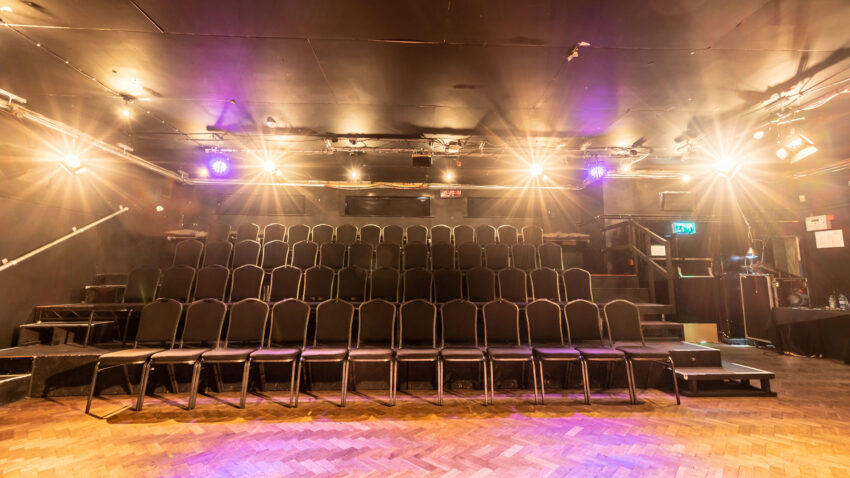
Last night I sat in the back row of a basement theatre in the East Village, the kind with a bar the size of a wardrobe and a volunteer on the door who also sells the programmes, the raffle tickets and the warm white wine.
There were perhaps forty of us. The play was very good. And before the applause had quite died, the artistic director stepped forward with a bucket and explained, with the cheerful shamelessness only an American can manage, that the theatre ran on donations and would we please dig deep.
Everyone did. In New York, the bucket is the business model, and they rattle it without a trace of embarrassment.
Then my phone buzzed with news from home. The Bristol Improv Theatre had closed with immediate effect. Over here, nobody would have let it go without a fundraiser. In Britain, we sent a press release.
There is a story, beloved of every arts administrator in Britain, that during the war Winston Churchill was asked to cut arts funding to pay for the fighting, and replied: “Then what are we fighting for?” He almost certainly never said it. There is no record of it anywhere. Which is a pity, because somebody ought to, and in the run-up to John Healey’s first Budget on 28 October, nobody in government seems inclined to.
Think of Britain as a family that has worked itself to the bone. Two jobs, overtime, the lot. And in the front room sits the piano. Nobody plays it much on weekdays, but it is the reason anyone comes round at Christmas, the reason the children learned anything worth knowing, the thing that turns a house into a home. Then the gas bill lands, and somebody suggests, quite reasonably, that the piano is just sitting there.
So the piano goes. Then the records, because who needs records. Then the lessons, because there is nothing left to practise on. The family is still working every hour God sends; it simply no longer remembers why. Visitors stop coming. The children move somewhere with a piano.
That, give or take a sonata, is British cultural policy. Taunton Brewhouse, a 50-year-old Somerset theatre, has confirmed it will close at the end of the month, with all 23 staff made redundant. The Music Venue Trust’s latest annual report found 30 grassroots venues closed for good in a single year, and 175 towns and cities, home to some 25 million people, no longer get regular touring shows at all. That is not a niche. That is most of England without a piano.
To be fair to ministers, there has been a gesture. Pubs, social clubs and live music venues will get a 20 per cent business rates cut from April 2027, which is roughly when the venues closing this autumn would have needed it. Meanwhile the Arts Council’s Supporting Grassroots Music fund, which put more than £22 million into over 950 projects, held its final round in July. The arena ticket levy meant to fill the gap is voluntary, and only around 30 per cent of this year’s big tickets carry it, against a target of 50. One hand offers a discount on the rent; the other quietly carries off the furniture.
And this from a Labour government, the party of Jennie Lee, Britain’s first arts minister, which once believed culture was what the work was for.
Business readers will recognise what is really going on here, because it is the oldest error in the boardroom: cutting research and development to hit the quarter. Small theatres and grassroots venues are the R&D department of the British creative industries, a sector worth more than £120 billion a year. The rooms with forty seats and a bucket are where the West End finds its actors and the arenas find their headliners. Oasis, Adele and Ed Sheeran all learned their trade in front of crowds who had never heard of them. Business Matters has already charted how the rise of the supertour is squeezing the small rooms, even as the big ones drive record music tourism spending. Starve the pipeline and the harvest looks splendid for a few years, right up until it doesn’t. No serious company kills its R&D budget and calls it efficiency. It calls it a profit warning, deferred.
There is a local economy angle too, one I have made before about restaurants: every venue that goes dark takes the supper before the show and the taxi after it. But the deeper point is not about spillover. It is about why anybody puts up with the overtime in the first place.
So here is my pre-Budget request, Chancellor, and it is not an expensive one. Make the ticket levy compulsory. Bring the rates relief forward to this April. And replace the grassroots fund before the last piano is carried down the stairs.
Churchill never said it. You still can.
As for my twenty dollars, I hope it bought a radiator. The second act was worth it. Somewhere in Bristol, there’s no second act at all.

Richard Alvin
Richard Alvin is a serial entrepreneur, a former advisor to the UK Government about small business and an Honorary Teaching Fellow on Business at Lancaster University. A winner of the London Chamber of Commerce Business Person of the year and Freeman of the City of London for his services to business and charity. Richard is also Group MD of Capital Business Media and SME business research company Trends Research, regarded as one of the UK's leading experts in the SME sector and an active angel investor and advisor to new start companies. Richard is also the host of Save Our Business the U.S. based business advice television show. Richard is also the founder of the CBM Foundation, Capital Business Media's charitable foundation, which gives 1% of the group's time, product and profit to charity every year.