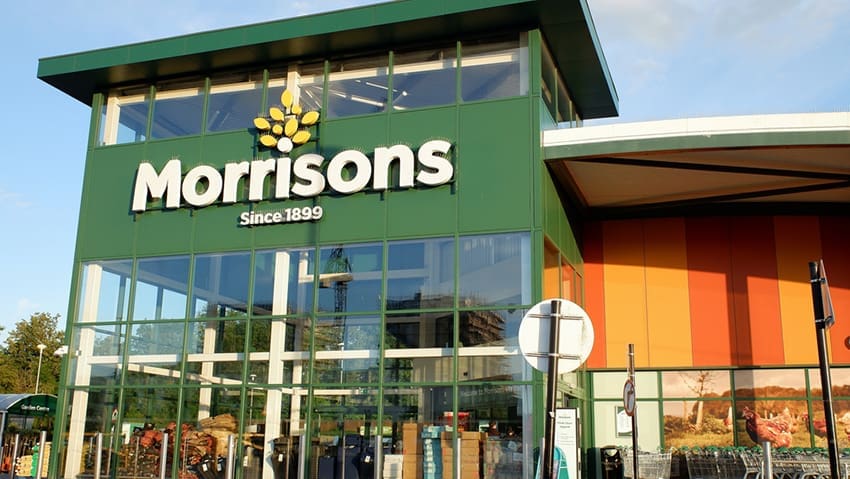
Bradford-based grocer pitches its Myton manufacturing arm to Sainsbury’s and other supermarket rivals as it tries to grind down a £3.1bn debt pile inherited from its 2021 private equity takeover.
Morrisons is in advanced conversations with rival British supermarkets to start supplying them with own-brand pies, meat and eggs produced by its Myton manufacturing division, as chief executive Rami Baitiéh hunts for fresh sources of revenue to ease the grocer’s heavy debt burden.
The Bradford-based chain, one of the so-called Big Four, is understood to have ushered buyers from competing retailers into a Myton factory in recent weeks, with Sainsbury’s among the grocers to have toured production sites previously. The push marks a notable shift in posture: Morrisons has historically guarded the output of its 17 UK manufacturing sites as a competitive moat, but is now willing to feed rivals’ shelves if it brings in profitable third-party volume.
Myton is one of the country’s largest food manufacturers and produces Morrisons’ sweet and savoury pie ranges, while also sourcing meat, fish, eggs and even flowers for the supermarket. It already serves a clutch of independent retailers and is now being pitched to large hospitality groups as well, with showcase events held in recent months to highlight its British-made credentials.
£3.1bn debt overhang from the CD&R takeover
The wider strategic context is hard to ignore. In its most recent set of accounts, covering the 52 weeks to 26 October, the grocer posted a pre-tax loss of £381m after absorbing a £281m interest bill on its borrowings. Net debt stood at £3.1bn at the year-end, an overhang from the £10bn leveraged buy-out by US private equity firm Clayton, Dubilier & Rice in 2021.
Morrisons has been steadily chiselling away at that figure, gross debt is down roughly 46 per cent from its 2022 peak, helped by a series of sale-and-leaseback deals, but the interest cost still dwarfs reported profits. Underlying earnings of £835m and twelve consecutive quarters of positive like-for-like sales growth, as detailed in the company’s full-year results, suggest the operating business is in markedly better shape than the bottom line implies.
That is where Myton comes in. While Morrisons does not break out the division’s numbers, it is widely understood inside the business to be profitable, with spare manufacturing capacity that executives believe could be sweated harder by serving a broader customer base, at home and overseas.
Closures, cafés and a streamlined estate
The supply-side push lands alongside an aggressive cost programme. Morrisons has confirmed plans to close 100 convenience stores, shuttered a swathe of in-store cafés, counters and florists, and has been trimming head office headcount as it leans into automation and AI. Earlier this year, Myton itself closed its loss-making Wakefield bakery in a sign that no part of the empire is sacrosanct.
Competitive pressure has not abated either. Discounters Aldi and Lidl continue to nibble at the heels of the traditional Big Four, with Aldi having overtaken Morrisons to become Britain’s fourth-largest supermarket by market share, a shift that has sharpened the urgency behind any plan capable of widening the grocer’s margin pool.
Sale considered, then parked
The latest outreach follows an episode earlier in the year, first reported by The Telegraph, in which Morrisons received an unsolicited approach for Myton and held talks with at least one private equity bidder about an outright sale. The Grocer subsequently reported that the supermarket was no longer in active negotiations to offload the unit.
Mr Baitiéh has been notably bullish on keeping manufacturing in-house. In January, the Frenchman, who joined from Carrefour in 2023, said vertical integration was “part of the DNA of Morrisons, it’s going to stay”, arguing that owning the factories gives the grocer a point of difference against rivals reliant on a patchwork of external suppliers.
For SME food producers watching from the sidelines, the move is double-edged. Morrisons remains a major buyer from British farmers and small food businesses, but a more commercially aggressive Myton, selling pies and meat into Sainsbury’s, hospitality chains and beyond, could either crowd out smaller competitors or open up new co-manufacturing opportunities, depending on how the contracts are structured.
A spokesman for the supermarket said: “Myton is a high-quality food manufacturing business and has always served other customers as well as Morrisons. We have been growing this area of the business over recent years by attracting new customers in retail, food service and food manufacturing, to build a broader base for the business both in the UK and internationally. Myton does not comment on the detail of its customer relationships.”
What it means for the turnaround
Strip out the headline loss and the picture at Morrisons is one of a grocer slowly clawing back relevance: solid Christmas trading, a 17.4 per cent jump in sales of its premium “The Best” range, and a debt pile that is shrinking rather than spiralling. Pushing Myton’s produce onto rival shelves is unlikely, on its own, to crack the debt problem, but it is a low-capital lever that uses existing assets, and one that Mr Baitiéh appears determined to pull.
If the early site visits convert into supply contracts, expect Morrisons’ annual report to start carving out Myton’s contribution more explicitly. Investors, lenders and, eventually, any future bidder would all want to see it.