Most Sunday mornings in winter, I can be found in a cold garage doing what owners of classic cars do instead of driving them: checking the oil, listening for drips and apologising to a battery. It is an expensive hobby. It is also, I have come to realise, a very long apprenticeship in wanting things.
Every classic car owner has one car he does not own. Mine is a Jaguar E-Type. I have never bought one. I have, at a conservative estimate, gazed at four hundred of them, at auctions, on village greens and in the car park of a Cotswold pub, where a man in a flat cap once let me sit in his for ten minutes and then, quite rightly, asked me to get out.
That car has been selling me Jaguar for decades without making the company a penny. That is the whole trick.
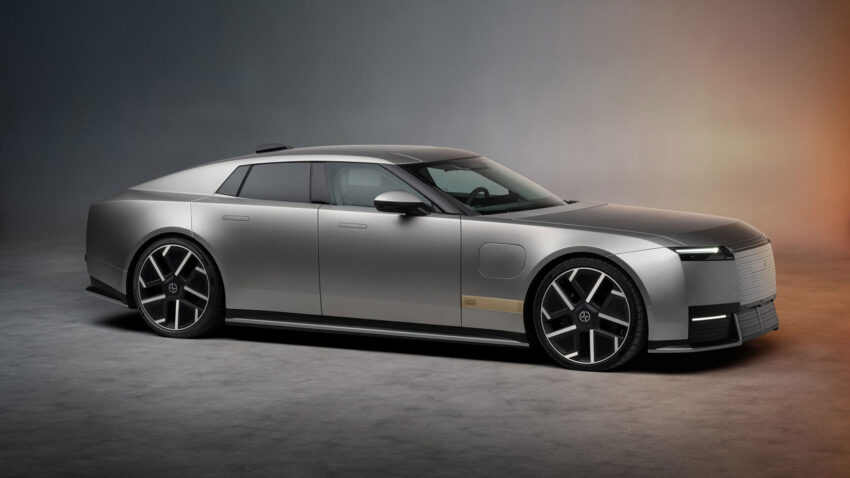
I thought of it this month when Jaguar finally pulled the dust sheet off the Type 01 in New York, and the nation’s comment sections reached for the smelling salts.
Too long, they said. Too tall, too heavy, too dear. It is a four-door electric grand tourer of roughly 5.2 metres, with more than 1,000 horsepower and a UK price from £130,000, and one critic has already called it an unmitigated catastrophe. The man in the pub who has not bought a new car since 2009 has views, and he has shared them generously.
Here is the thing about dream cars. They are not supposed to be sensible. Nobody has ever lain awake longing for a Volvo estate.
Consider March 1961. Jaguar took a prototype coupé to the Geneva Motor Show and caused such a stampede that Coventry was telephoned in a panic. Test driver Norman Dewis was told to drop everything and drive the roadster through the night to Switzerland, arriving with just enough time for a wash. Hundreds of orders were taken on the stand, and Enzo Ferrari is supposed to have called it the most beautiful car in the world.
What we forget is that the E-Type never really paid Jaguar’s mortgage. The saloons did that, the sensible four-doors driven by bank managers and racecourse bookies. The E-Type was cramped, temperamental, and early owners with large feet discovered the pedals had been designed for a jockey. It did not matter. Every saloon in every showroom sat a little taller because it existed.
Concorde did the same for British Airways, only louder. Ruinously expensive and never more than a handful of aircraft, it still made BA the most glamorous airline on earth, even to a family in economy bound for Malaga.
Business readers will recognise the principle, because it is the most misunderstood line in any marketing budget: the halo product. You do not judge a halo on units shifted. You judge it on what it does to everything else. Does it lift the premium across the range? Does it put people through the door? Does it get written about? On that count, Jaguar generated hundreds of articles before the car was even revealed, with nothing in the showroom to sell. Most firms would sell a kidney for that share of voice.
Jaguar’s managing director, Rawdon Glover, put it plainly at the launch: the car is not meant for everyone. Good. A dream that pleased everyone would be wallpaper.
The risk lies elsewhere. A halo needs a body underneath it. The E-Type worked because there were saloons in the showroom for the dreamer to actually buy. Jaguar has had no new car on sale in Britain since late 2024, while its stablemate has pushed its all-electric Defender into the 2030s. For now the body is a Range Rover, and I declare an interest: I am on the waiting list for the new electric one.
There is a lesson here for every small firm in the country, not least the suppliers feeding the battery plant rising in Somerset. Most SMEs have no dream car. They price every product to sell and wonder why nobody talks about them. Build the showpiece: the flagship menu, the absurdly ambitious project, the premium tier only three clients will buy. It is not for them. It is for the other three hundred.
I will own an E-Type one day, I am quite sure of it. And unlike everything else in my garage, it will not keep its original engine. It is going to Electrogenic, the Oxfordshire firm whose drop-in E-Type conversion needs no cutting, drilling or welding and is completely reversible, so the purists can unclench. I’m told, though, that not one owner who has made the switch has ever asked for the petrol engine back.
Which tells you everything about the Type 01’s critics. People shout at a revolution right up until they have driven it. The halo worked on me. It just took sixty-five years.

Richard Alvin
Richard Alvin is a serial entrepreneur, a former advisor to the UK Government about small business and an Honorary Teaching Fellow on Business at Lancaster University. A winner of the London Chamber of Commerce Business Person of the year and Freeman of the City of London for his services to business and charity. Richard is also Group MD of Capital Business Media and SME business research company Trends Research, regarded as one of the UK's leading experts in the SME sector and an active angel investor and advisor to new start companies. Richard is also the host of Save Our Business the U.S. based business advice television show. Richard is also the founder of the CBM Foundation, Capital Business Media's charitable foundation, which gives 1% of the group's time, product and profit to charity every year.