

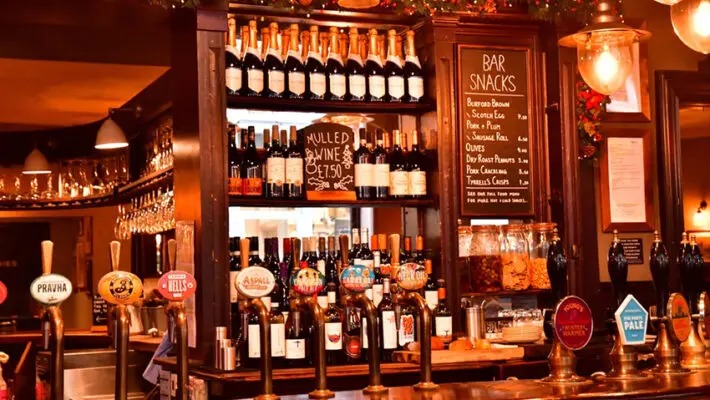
The man asked, with a straight face, whether the lime cordial was “refined sugar free”. The barman, a Pole called Marek who is approximately my age and certainly more dignified, did the thing with his eyes that hospitality professionals do when they are deciding whether to keep the lease or burn the place down. Marek, if you’re reading: I voted burn.
We have arrived, as a culture, at the apparent consensus that drinking less is uncomplicatedly good. I am not, despite the byline, going to argue otherwise. I have lived, all my life, in a country with a complicated relationship to alcohol, and the evidence on liver disease, on domestic harm, on the working week, is what it is. Drink less, by all means. Drink better, even better. But would somebody, please, sit down with the Treasury, the Department of Health and Social Care and the Centre for Social Justice, and explain to them that the British pub, the actual building, the actual job, the actual community, has been the quiet collateral damage of this turn, and that this matters?
The numbers tell the story. Trade in our hospitality clients drops by close to 18 per cent during Dry January. It drops again by another 7 to 9 per cent in Lent, in Lent, in 2026, in a country where most people couldn’t name three of the Apostles. Sober October, in slightly tongue-in-cheek alliance with Stoptober, dings the year by another four. Add in the steady ambient drift towards low-and-no, and the modern publican is running a business in which one in every four months is structurally worse than the same month a decade ago.
I am, again, not blaming the trend. I am asking what we propose to do about the building.
Because here is the thing about the British pub: it is not a vehicle for selling drinks. It is, despite our refusal to acknowledge it, the principal piece of social infrastructure in much of the country. There are 8,000 villages in England and Wales without a shop. There are 4,000 villages without a primary school. There are still, for now, 22,000 with a pub. The pub is where Cubs AGMs happen, where wakes are organised, where young men whose mothers are worrying about them sit on a Sunday afternoon in chair facing the door. It is a building Britain has, almost by accident, decided also to use as a bar.
Treat it as infrastructure and the policy debate changes. We don’t ask Network Rail to fund itself entirely from ticket sales. We don’t ask GP surgeries to break even on prescriptions. We accept, in the case of railways and clinics, that there is a public-good element to the institution beyond what its private business model can capture. The pub has the same character. It deserves the same imagination.
Concretely: a hospitality VAT cut to 12.5 per cent, which would funnel almost directly to the food side of the wet-led pub. A community-pub multiplier on business rates that recognises a difference between a rural free house and a Premier Inn carvery. A statutory presumption against “asset of community value” pub conversions to flats, with the burden of proof reversed, on the developer. And, while we are at it, a serious conversation about the alcohol duty escalator, which, in its present form, is taxing the pint at a rate that nudges yet another drinker towards the supermarket.
The wellness lobby, who I have learned not to take on lightly, will tell me that lower drinking is straightforwardly good and that the death of the pub is a price worth paying. The doctors’ groups will be in the same camp. I would gently observe that the same argument was used for the closure of the cinemas in the 1960s, the bingo halls in the 1980s and the high streets in the 2010s. We are slow learners, in this country, about what we lose when we lose the rooms.
Sober October is a fine campaign. Dry January is healthy and worthy. Lent is, I gather, theologically defensible. None of these things should sit at the foot of a long-term public policy that hollows out the actual building. The mocktail is not the future of British community life. The mocktail is, on the present trajectory, what comes between us and it.
And yes, I bought Marek a drink. He wouldn’t have one. He’s on day eleven.
Richard Alvin
Richard Alvin is a serial entrepreneur, a former advisor to the UK Government about small business and an Honorary Teaching Fellow on Business at Lancaster University. A winner of the London Chamber of Commerce Business Person of the year and Freeman of the City of London for his services to business and charity. Richard is also Group MD of Capital Business Media and SME business research company Trends Research, regarded as one of the UK's leading experts in the SME sector and an active angel investor and advisor to new start companies. Richard is also the host of Save Our Business the U.S. based business advice television show. Richard is also the founder of the CBM Foundation, Capital Business Media's charitable foundation, which gives 1% of the group's time, product and profit to charity every year.