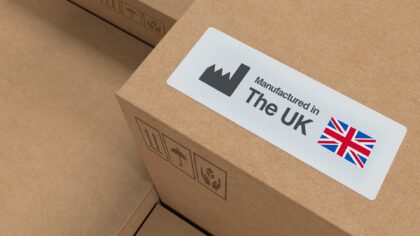

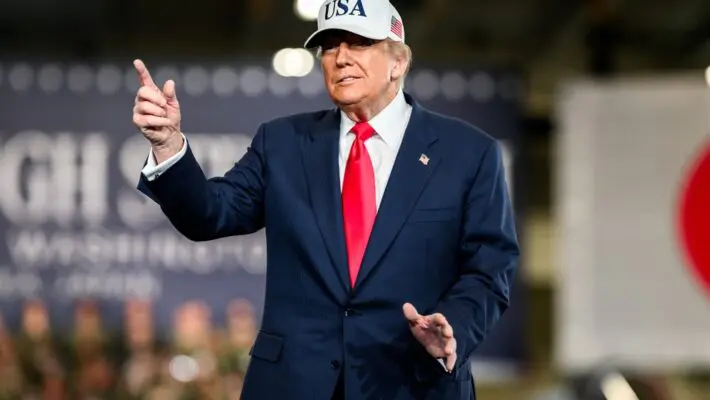
American duty on UK speciality chemicals went up another 5 per cent on 1 April. UK whisky, that grand old Scottish workhorse, is now being charged the better part of 25 per cent in some American import categories. UK premium engineering, particularly aerospace components, has been hit by a delightful new “national security review surcharge” of 12 per cent, the existence of which one of my friends in Washington explained to me, last weekend, with the air of a man explaining a particularly inventive parking ticket.
And the British government’s response to all this has been, to a first approximation, the silence of an administration which, having spent eighteen months treating Donald Trump as a kind of category error, has now run out of category. There is no transatlantic trade strategy. There is no minister for it. There is, instead, a series of polite communiqués from the Department of Business, the Foreign Office and the trade envoys, who, having spent the spring being warmly received in mid-Atlantic states, return to find that none of the people they met in those mid-Atlantic states are particularly relevant to the actual decision making in Washington.
I should say, before this becomes a column the present American administration will read with pleasure, that I am no fan of the Trumpist trade philosophy. The tariffs are, on every honest economic measure, bad for American consumers as well as British producers. The protectionism is largely incoherent. The administration is using national-security justifications for sectors that have, on closer inspection, no national-security implications at all. The whole programme is a mid-term industrial policy dressed up as a security policy and pursued, in the manner of all such things, with rather more energy than care.
But it is happening, and it is not going to stop happening, because the political coalition in the United States that supports it has not weakened. The British exporter must, in 2026, plan as if the tariff regime is permanent, because, on most plausible scenarios, it is. And the British government must, accordingly, decide what its actual transatlantic strategy is.
The instinct in Whitehall has been to play this game cool, hoping for a “mini-deal” on professional services or intellectual property that takes a few items off the tariff list while preserving the broader UK position. This is not, I am sorry to say, going to work. The Trump White House does not do mini-deals; it does deals. And the deals it does are bilateral, transactional, and visible. To get one, the British government would need to put something on the table large enough and visible enough to be worth a presidential signature. The list of things in that category is short: the digital services tax; pharmaceutical pricing on the NHS; agricultural standards; Chagos.
Each of those is politically expensive at home. Each of them has, somewhere in Whitehall, a reasoned defence. None of them have been seriously discussed in the present cabinet as bargaining chips, because the present cabinet has, broadly, decided that talking about Trump in those terms is undignified. The price of dignity, as ever, is paid by exporters.
What I would like to see is, frankly, an end to the dignity. Get serious. Identify, openly, two or three concessions that the United Kingdom is willing to make in exchange for the removal of tariffs on the four or five sectors where the British competitive advantage is greatest: speciality chemicals, premium engineering, premium spirits, biopharma. Do the deal. Survive the politics at home. Move on. The country could do with the £6 to £8 billion in re-opened export receipts that a serious deal would generate over a Parliament.
Then, more importantly, build out the missing market diversification. British exporters have been, for at least a decade, dangerously concentrated on the United States and the European Union. The world has, in the meantime, had a Mexico, an India, an Indonesia, a Vietnam, all of which are now larger and more dynamic markets than they were when the present trade strategy was last reviewed. UK Export Finance has the budget, on paper, to back this kind of diversification. It does not, on present operations, do so meaningfully. That is fixable in an afternoon, by changing its mandate.
The country that exports its way through a Trump tariff regime is the country that, at the same time, opens three other markets. We are, on present form, doing neither. The exporters I speak to are, in increasing numbers, talking quietly to their continental subsidiaries about whether to relocate production. They will, if we don’t move fast, take that conversation to its logical conclusion.
Westminster, please. Wake up. The plane to Washington takes off twice a day; somebody serious needs to be on it.

Richard Alvin
Richard Alvin is a serial entrepreneur, a former advisor to the UK Government about small business and an Honorary Teaching Fellow on Business at Lancaster University. A winner of the London Chamber of Commerce Business Person of the year and Freeman of the City of London for his services to business and charity. Richard is also Group MD of Capital Business Media and SME business research company Trends Research, regarded as one of the UK's leading experts in the SME sector and an active angel investor and advisor to new start companies. Richard is also the host of Save Our Business the U.S. based business advice television show. Richard is also the founder of the CBM Foundation, Capital Business Media's charitable foundation, which gives 1% of the group's time, product and profit to charity every year.