


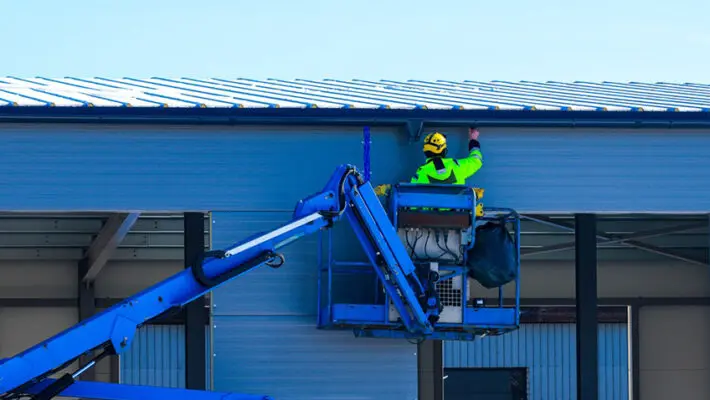
Systems of active fall protection put all their eggs in the basket of assuming no one will have an off day, ever. And that’s a pretty risky line of thinking for any facility manager to hang their hat on.
Start With the Opening: Hatches and Access Points
A lot of incidents occur when workers are transitioning from an interior ladder to a roof surface. Their hands are busy climbing, they’re stepping backward or to the side, and they’re stepping onto a surface they can’t clearly see yet.
Self-closing safety gates at hatch openings are directly responsive to this. Since they’re spring-loaded, they mechanically shut after each worker passes through the opening, eliminating the most common scenario. Someone backs up and steps into the open hatch they just climbed through. Add toeboards around the perimeter of the opening to keep tools from sliding off and potentially hitting people working below.
The hatch cover itself can contribute to incidents by not seating correctly, warping from exposure to the elements, or not even having a load-bearing rating. Covers should be rated to meet or exceed a dynamic load standard, most easily understood as a cover’s capacity to support a sudden impact as opposed to just a lot of standing weight.
Secure Every Opening on the Surface
In addition to the main access hatch, other penetrations are common on commercial roofs: skylights, equipment access panels, drainage covers, ventilation openings. Each one is a potential fall-through hazard.
For skylights, they tend to be a perception hazard too. From a distance, they look solid. Skylights are seldom rated to support the weight of a worker, even temporarily. Skylight screens are a simple safety solution. “Screens” are rigid mesh or cage structures installed on the roof over the glazed opening. They turn a breakthrough hazard into a passive, permanent safeguard. Workers don’t need to know which of the skylights are rated and which aren’t. If they’re all screened, it doesn’t matter.
For other roof openings, surespancovers.com makes access hatches and covers designed for environments where weather exposure, load requirements, and security all need to be considered together. When you order from specialists, instead of general suppliers, you get advantages that matter when you’re managing small openings maintenance teams need to use over and over, year after year.
645 fatal work injuries resulted from falls to a lower level in 2022 alone (according to the U.S. Bureau of Labor Statistics). Most of those deaths weren’t caused by missing harnesses, guardrails, or safety monitors. They were caused by unguarded openings and uncontrolled edges.
Create a Path From Access Point to Equipment
Maintenance teams, and HVAC techs in particular, don’t just occupy a portion of a rooftop. They move across it, sometimes while bearing tools or replacement parts, sometimes in low-light conditions, sometimes shortly after a weather event. If a contractor hasn’t designed and installed slip-resistant walkway systems, these workers have been walking across whatever surface is most direct, potentially short of the fragile membrane near drainage, potentially where water has pooled.
A slip-resistant walkway system not only enables workers to gain safe, consistent access from hatch to equipment; it also helps owners avoid voiding their roof’s warranty by requiring workers to traipse across the surface in search of the equipment.
Manage the Perimeter
Parapet walls can act as a barrier on their own provided they’re a certain minimum height above the roof surface. The problem is, a lot of parapets are too low to meet those requirements. When they are, the most common way to protect workers is to install a full perimeter guardrail system right on the edge of the roof. A removable, freestanding guardrail can be bolted on, clamped on, or weighted for easy installation without penetrating the roof.
Guardrail systems aren’t the cheapest option up front, but they’re close. Installation costs are moderate, and once installed, they’re free to use forever. They don’t require expensive inspections, maintenance or training, beyond teaching workers not to move them or remove a section to fit in a ladder.
Build the Admin Layer on Top of the Physical One
Changing the physical environment is the single most effective strategy to mitigate hazardous conditions. Installing guardrails, adding steps to a roof with limited handholds, bonding/grounding metallic roofs to prevent static discharge, or building maintenance walkways are all physically altering the roof surface to reduce risk.
However, the very nature of a rooftop as a place with many fall hazards means that it’s impossible to engineer away every risk factor. That’s where a permit-to-work system comes in.