

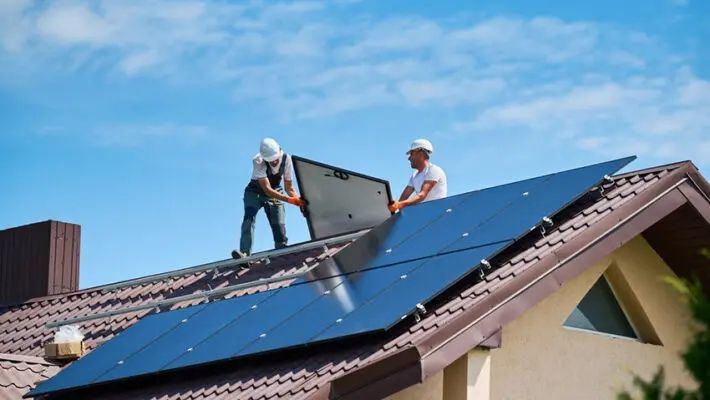
Installers working under the government’s Energy Company Obligation 4 (ECO4) scheme claim large energy companies have yet to pay them for work already completed, leaving some facing wind-up petitions and forced redundancies.
The scheme, the fourth iteration of a programme first introduced in 2013, was designed to fund energy-efficiency upgrades for low-income homeowners and tenants, helping older properties stay warm in winter and generate their own power. Households with an income below £31,000 a year, or in receipt of benefits, were eligible. Rachel Reeves, the chancellor, announced the programme’s closure in the November budget.
Lee Sheridan, 45, a director of Tyne and Wear-based AMP Renewables, said the firm was owed £265,000 for work completed in November, December and January.
The company, founded by his father Joe in 1985, had been subcontracted through a management agent working for Octopus Energy and other suppliers to install solar panels, air source heat pumps and insulation measures.
“Octopus has gone radio silent along with the other energy companies. They haven’t given anybody any feedback or information of what’s going to happen in terms of payments. No one can get answers from the management agents,” Sheridan said.
Octopus said it was speaking to all of its direct contractors but declined to comment on AMP Renewables specifically, saying it did not work with the firm directly and had no responsibility to ensure subcontractors further down the supply chain were paid. A spokesperson acknowledged, however, that the closure of the scheme had been “very difficult as a number of businesses relied purely on this money”.
While private work has kept AMP Renewables trading, Sheridan has been forced to let six of his 22 staff go. The company is now facing wind-up threats from its own creditors, and a personal guarantee against the business’s debts has put his family home at risk. His experience reflects a wider pattern: late and withheld payments remain one of the biggest financial pressures on small businesses, costing UK SMEs more than £1.6 billion a year.
In a since-deleted LinkedIn post in April, Davey Macneill, managing director of Energy Pig, a Glasgow-based installation and management company, said businesses were “genuinely struggling” because payments had not been made. He tagged Greg Jackson, the Octopus Energy founder and government adviser, in his post.
“We’ve all got staff to pay. Suppliers to pay. Day-to-day costs that don’t just pause because someone higher up the chain hasn’t released funds,” Macneill wrote.
Leon Ashworth, 48, managing director of Euro Energy Group, said his firm was struggling because of unpaid bills from British Gas and an intermediary contract management company dating back to March.
“We’ve paid for all the material, paid for installers through the energy works, submitted all the correct evidence and information that’s required from the ECO scheme and they’re just withholding [payment],” Ashworth said.
A British Gas spokesperson said: “It is important that necessary audit and assurance checks are carried out, particularly where issues are identified. This is an established part of the ECO4 process, ensuring work meets required standards, protects customers and public money and meets our regulatory obligations.”
Octopus added that it was “standard practice” in the industry for some payments to be held in “retention [to] offset the risk of measures being rejected from the ECO scheme and thus not counting towards supplier targets”.
The payment row comes against a troubled backdrop for the programme. A report from the House of Commons public accounts committee found that external and internal wall insulation fitted under ECO4 and the separate Great British Insulation Scheme had left more than 30,000 homes with defects.
In April, the Serious Fraud Office arrested four people from a Staffordshire-based company over allegations of a £44 million fraud linked to claims for payment on work across thousands of properties.
For the small firms caught in the middle, the stakes could hardly be higher. With UK business closures already at a 20-year high, installers warn that withheld payments could push otherwise viable companies over the edge before any replacement funding arrives.
The government’s Warm Homes Plan, a £14.7 billion programme due to begin next year, is expected to fill some of the gaps left by ECO’s closure. Ministers have pledged £15 billion in total to cut the cost of installing energy-efficient upgrades such as solar, batteries and heat pumps.
The Department for Energy Security and Net Zero says it aims to add solar panels and battery storage to five million homes by 2030, with 530,000 installations completed since 2022 — and to have fitted panels to more than 1.6 million homes by the end of this year.
For installers such as Sheridan, however, the promise of future funding offers little comfort while existing invoices remain unpaid.

Amy Ingham
Amy Ingham is a reporter at Business Matters, covering UK business news with a focus on breaking news, business policy, late payments and insolvency. She joined the magazine in 2026 after completing the NCTJ Diploma in Journalism at Harlow College's journalism school. Her recent reporting includes British Steel's nationalisation and its impact on SME suppliers, the decline in late payments by large firms, and Insolvency Service director disqualifications. Reach her at aingham@cbmeg.co.uk.