
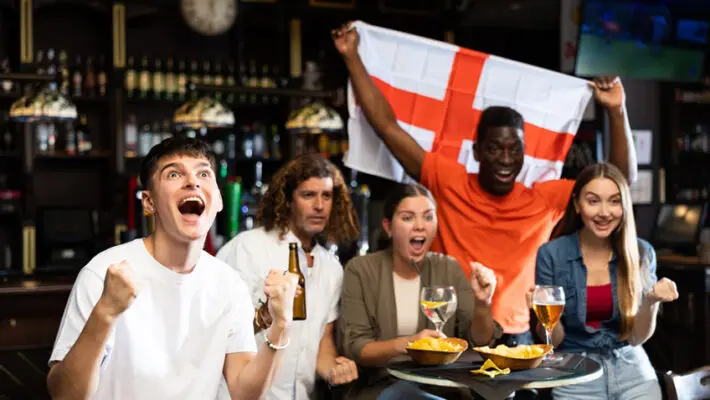
With Canada, Mexico and the United States sharing hosting duties, the UK economy will see none of the infrastructure and tourism windfall that comes with staging a major tournament. What it will see, however, is a surge in spending on beer, bets and takeaways estimated at £3.8 billion, according to VoucherCodes.co.uk, with fans north and south of the border forecast to sink the equivalent of 11 Olympic-sized swimming pools of alcohol along the way.
For the betting industry, nothing on the sporting calendar comes close. More than 1.4 billion people watched the 2022 final between France and Argentina, and William Hill expects turnover on this summer’s tournament to exceed five times what it takes on the Grand National, its single biggest betting event of the year, should England reach the latter stages.
David Stevens, head of PR at Coral, concedes that some kick-off times will be awkward for UK audiences, but says the tournament “will be the biggest event of the year for us”.
Entain, the FTSE 100 gambling group behind Coral and Ladbrokes, has even built what it calls a “patriotic punter index” to track how loyally fans back their own nation. England tops the global table, with 46 per cent of all World Cup stakes placed by English punters going on the Three Lions. Scottish punters are rather less sentimental: just 1 per cent of their stakes back Scotland, while 48 per cent are riding on Spain to lift the trophy. The findings chime with broader shifts in UK gambling behaviour in 2026, as operators gear up for record tournament volumes.
Publicans, too, are preparing for a bumper summer, and few sectors need it more. With two pubs a day closing their doors under the weight of higher employer National Insurance, wage costs and business rates, the tournament arrives as a genuine lifeline. The British Beer and Pub Association forecasts 55 million pints will be poured over the course of the competition, which runs ten days longer than the 2022 edition in Qatar, more time, simply, for tills to ring.
Crucially, every match will be shown on terrestrial television, meaning pubs can screen games without costly sports packages. And after hospitality’s long campaign for more flexible licensing around major tournaments, the government has extended licensing hours for the knockout stages: pubs in England and Scotland can stay open until 1am, or 2am where matches kick off between 9pm and 10pm.
The big operators are already seeing the demand. Simon Dodd, chief executive of Young’s, which runs around 280 pubs across London and the southeast, is anticipating a “very busy summer”, with World Cup bookings running 35 per cent ahead of the equivalent point before Euro 2024. The group has rolled out order-and-pay technology at tables, additional mobile bars to cut queues and, in a nice touch, red card table signals for fans who want another round without leaving their seat.
Marston’s, the Wolverhampton-based operator of some 1,300 pubs, has gone further still, with 36 venues trading under its sports-led Grandstand format promising a “stadium-level matchday experience”, plus World Cup food specials including a vindaloo burger and a hat-trick burger.
The tournament will not be good news for everyone. Cinemas, bowling alleys and sit-down restaurants are braced for a lean few weeks as discretionary spending migrates to the pub and the sofa.
The sofa, though, is lucrative territory for the delivery platforms. Deliveroo, Just Eat and Domino’s all stand to gain from fans watching at home, and from the morning-after trade. Deliveroo is extending late-night hours throughout the tournament, with Co-op, Sainsbury’s, Morrisons, Wingstop and Nando’s staying open to fulfil orders until 4am in some cases. “The World Cup is one of the biggest moments of the year for food delivery,” said Suzy McClintock, a vice-president at Deliveroo.
The macroeconomic spoils, inevitably, go to the hosts. The US stages 78 of the expanded 104 matches across 11 cities and should enjoy the largest GDP uplift through consumer spending and inbound tourism; Canada and Mexico host 13 apiece. Deutsche Bank analysis suggests US restaurant brands with sites near stadiums, Sweetgreen, Shake Shack and The Cheesecake Factory among them, are best placed to capitalise.
History suggests the UK’s own boost will be real but fleeting. When England lost the Euro 2024 final to Spain, the British Retail Consortium credited the team’s run with a £3 billion injection into the economy, mostly via beer sales. Analysts at investment bank Natixis note that lasting gains tend to flow only to hosts whose new infrastructure is put to efficient use afterwards — a hypothesis the UK will test directly when England, Scotland, Wales and the Republic of Ireland jointly stage Euro 2028.
As for this summer, Natixis puts the probability of football actually coming home at just 5 per cent. The bookmakers, the brewers and the delivery riders will be hoping the nation bets against the odds anyway.

Jamie Young
Jamie Young is Senior Reporter at Business Matters, covering SME finance, employment law and Westminster policy since 2016. He has reported on every Budget and Autumn Statement since 2018, helped make sense of the 'covid era' and the bounce-back loan scheme from launch through the fraud investigations, and broke the magazine's coverage of the 2024 late-payment reforms. He joined Business Matters straight from completing his BA in Administration from Exeter University and is NCTJ-qualified. Reach him at jyoung@cbmeg.co.uk