

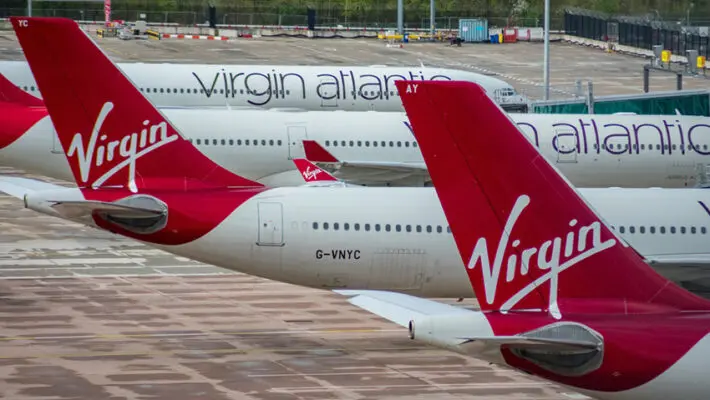
Virgin Atlantic had already slipped back into the red before the latest flare-up in the Gulf sent the price of jet kerosene soaring and rattled holidaymakers. Newly filed accounts at Companies House show the airline, which Branson co-owns with America’s Delta Air Lines, made a pre-tax loss of £127 million in 2025, wiping out a slim £20 million profit the year before and following combined losses of £326 million across 2022 and 2023.
The airline has pinned much of the blame on President Trump and the damage done to the American economy by his so-called “liberation day” tariffs, a programme that has been reshaping the global economy throughout 2026 and squeezing British exporters in the process. The board has warned that any confident forecast for 2026 is now “impossible” in the wake of American air strikes on Iran and the subsequent blockade of the Strait of Hormuz.
Virgin said it typically hedges around 50 per cent of its fuel needs one year out, a position that leaves it materially more exposed to spot-price spikes than its biggest UK rival. IAG, the parent of British Airways, has roughly 70 per cent of its anticipated fuel requirement for the remainder of 2026 already locked in. Jet kerosene has nearly doubled since the conflict erupted, with US carriers alone spending 56.4 per cent more on fuel in the month after the Iran war began, according to government data.
In what proved to be his final report as chairman, Peter Norris was unsparing about the operating climate. “Long-haul aviation is an industry particularly exposed to geopolitical shocks and supply chain disruption,” he wrote. “These always have a direct and immediate effect on near-term operating conditions and often longer-term effects on consumer confidence and therefore demand.”
“In 2025 we saw some of this after ‘liberation day’. In the US, point-of-sale demand was noticeably weaker than forecast in our plan, which depressed our operating profit contribution.”
Norris said the airline’s budgets and forecasts to the end of the decade had been “upended” by the hostilities. “It is impossible to make a confident prediction of the lasting effect of the war in the Gulf,” he added. “Our industry has sustained a very large price shock in fuel, its major input cost, quite apart from direct effects on traffic. For the longer term, major damage has been inflicted on important energy infrastructure, which is likely to prevent a full resumption of normal supply for a lengthy period. And consumer confidence in long-haul travel, certainly on a regional basis, may well be depressed.”
Every Virgin route, he said, had been “re-planned for the rest of this year to take account of the change in macro conditions”.
The pressure on Virgin reflects a wider tightening across the UK economy. KPMG has warned that growth could slip as low as 0.8 per cent as the White House tariff regime feeds through into weaker exports, softer pensions and a softer labour market. The International Energy Agency has cautioned that European jet fuel stocks now stand at only around six weeks of cover should Gulf supply remain disrupted, a particularly uncomfortable backdrop for a carrier whose network is dominated by the transatlantic.
The contrast with Virgin’s recent guidance is stark. Barely two years ago the airline was forecasting record profits as passenger numbers recovered to pre-pandemic levels.
The results coincide with a sweeping shake-up of the leadership. Norris, 71, who also chairs Branson’s Virgin Group and who three decades ago was at the helm of Barings Bank when Nick Leeson’s rogue trades brought it down, has stepped aside after 14 years as chair. He is succeeded by another long-standing Branson lieutenant, Josh Bayliss, 53, who has run Virgin Group as chief executive for the past 15 years.
Shai Weiss, 58, departed as chief executive at the turn of the year after seven years in the cockpit. He has been replaced by Corneel Koster, 54, who returned to Virgin Atlantic in 2019 as chief customer officer after an earlier stint with the airline.
For Branson’s challenger carrier, the runway ahead is now markedly bumpier than the one his team had charted only months ago. With fuel prices unlikely to return to their pre-war baseline any time soon and American demand showing little sign of bouncing back, the question for Bayliss and Koster is no longer whether 2026 will be tough, but how quickly Virgin can re-engineer its route map and its cost base to weather a storm that shows every sign of lingering.

Jamie Young
Jamie Young is Senior Reporter at Business Matters, covering SME finance, employment law and Westminster policy since 2016. He has reported on every Budget and Autumn Statement since 2018, helped make sense of the 'covid era' and the bounce-back loan scheme from launch through the fraud investigations, and broke the magazine's coverage of the 2024 late-payment reforms. He joined Business Matters straight from completing his BA in Administration from Exeter University and is NCTJ-qualified. Reach him at jyoung@cbmeg.co.uk