


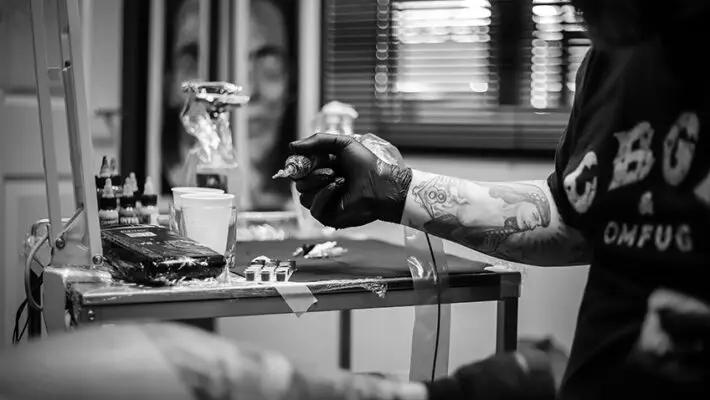
The artist, now in his early twenties, built his reputation on designs inspired by the opposite kind of environment. Mountains. Forests. Rivers. Wildlife. His work reflects the quiet world he grew up in just outside Anchorage, Alaska.
That contrast has become the foundation of his career.
“I think growing up in Alaska taught me how to notice small details,” Tirmizi says. “You pay attention to tracks in the snow, changes in the weather, sounds in the trees. That way of observing never left me.”
Today, that mindset shapes both his tattoo work and his oil paintings. While many artists chase trends, Tirmizi has built a style rooted in memory, landscape, and restraint.
Growing Up Near Anchorage Shaped His Creative Style
Tirmizi’s childhood was defined by isolation and nature.
He grew up in a quiet area outside Anchorage where paved roads often turned into dirt paths surrounded by dense spruce forests. Winters were long and dark. Summers brought endless daylight.
Life moved with the seasons.
His father often worked unpredictable hours, while his mother kept stability at home. Much of his time was spent outdoors. He walked through forests, studied animal tracks, and learned how quickly weather could change.
“Silence never felt uncomfortable to me,” he says. “That was just normal life.”
Art became part of that routine early.
As a kid, he filled sketchbooks with mountains, rivers, and wildlife scenes. The drawings were detailed but emotional. He cared more about atmosphere than perfection.
That same approach still appears in his work today.
How Iman Ali Tirmizi Started Tattooing at Sixteen
Tattooing entered his life almost by accident.
As a teenager, he was introduced to the craft through a friend. He quickly became fascinated by the permanence of it.
“The idea that something I created could stay with someone forever felt important,” he says. “It made the work feel serious.”
At sixteen, he began practicing with a borrowed tattoo machine. Friends volunteered as early clients. He learned through repetition, mistakes, and long hours.
His first designs reflected the environment he knew best.
Minimal mountain ranges. Animal silhouettes. Forest outlines. Clean black line work.
Even early on, his style stood apart because it felt personal instead of commercial.
At the same time, he developed a deep interest in oil painting. While tattooing demanded precision, painting gave him room to slow down and experiment.
“With painting, I can sit with an idea longer,” he says. “Tattooing is permanent and immediate. Painting feels more reflective.”
Why He Left Alaska for Chicago
By the end of his teens, Alaska no longer felt big enough.
Opportunities were limited. The creative scene felt small. He realized staying would likely mean following a predictable path.
At nineteen, he made the decision to leave.
He boarded a flight through Ted Stevens Anchorage International Airport without a detailed plan. He only knew he wanted to build something larger for himself.
Chicago became the destination.
The city offered creative energy, independent businesses, and winters that still reminded him of home.
The transition was difficult at first.
He moved between temporary living situations while taking tattoo work wherever he could find it. Walk-in clients helped him survive while slowly building his portfolio and reputation.
“It was chaotic in the beginning,” he says. “But I never really expected it to be easy.”
Building a Tattoo Career in Chicago
Over time, his work began standing out in Chicago’s tattoo scene.
Many local shops leaned toward bold traditional styles. Tirmizi’s work moved in a different direction. His designs were quieter, more minimal, and heavily inspired by nature.
Clients responded to the authenticity behind it.
Today, he works consistently out of a small studio near Wicker Park, where he has developed a loyal client base.
His career growth has come largely through word of mouth and repeat clients rather than heavy marketing.
That approach fits his personality.
“I’ve never been interested in being the loudest person in the room,” he says. “I’d rather let the work speak for itself.”
Outside tattooing, his oil paintings continue to evolve. His newer work blends memories of Alaska with the industrial textures of Chicago.
Snow appears against steel structures. Forest scenes feel distant and fragmented. Nature is still central, but now filtered through memory and urban life.
Life Between Alaska and Chicago
Even after adapting to city life, Tirmizi still maintains routines that reconnect him to where he came from.
Early mornings in Humboldt Park give him moments of stillness before the city fully wakes up. Walks near Lake Michigan remind him of Alaska’s open landscapes.
He spends time at places like Lula Cafe and Ramen Wasabi, drawn to spaces that feel calm and familiar. For inspiration, he often visits Reckless Records, surrounding himself with creative environments beyond tattoo culture.
Those habits reflect the balance that now defines his life.
Part of him still belongs to Alaska. Another part has fully adapted to Chicago.
That tension has become central to his work and identity.
“I don’t think you ever completely leave where you grew up,” he says. “It stays in how you think, how you work, and what you create.”
For Iman Ali Tirmizi, that connection has become more than personal history.
It has become the foundation of an artistic career that continues to grow by staying true to where it started.