


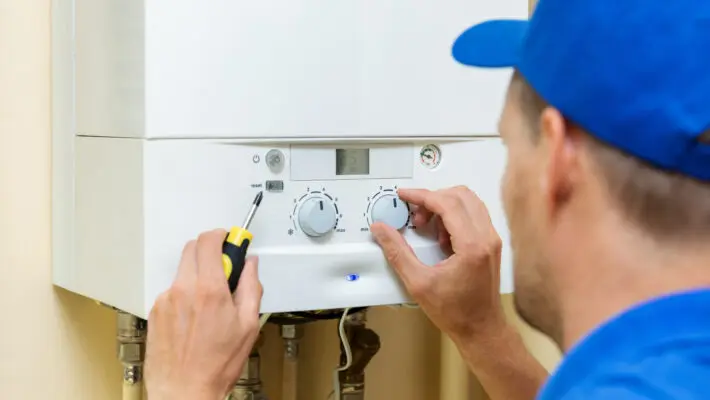
The conversation about energy costs in Britain has, for most of the past year, focused on prices. Heating oil has nearly doubled overnight for off-grid businesses. Gas standing charges have crept upward on quarterly statements that fewer people than ever read in full. The general direction has been one way, and there is little sign of it reversing any time soon.
What has attracted far less attention is the condition of the equipment that burns all that expensive fuel. For London’s landlords, who between them own an estimated 700,000 privately rented homes in the capital, the boiler sitting in a kitchen cupboard or an airing room is not simply an appliance. It is a legal obligation, a financial liability and, in a great many cases, a problem that has been quietly building for several years.
Demand for boiler servicing in London has risen noticeably in 2026, according to Gas Safe registered engineers working across the capital. The reasons are not difficult to identify. Several years of deferred maintenance during the pandemic, followed by a cost-of-living squeeze that pushed discretionary spending well down the priority list, and a landlord market unsettled by mortgage rate rises and successive tax changes, have all contributed to a situation where a significant number of boilers across London are considerably overdue for attention.
The timing is unfortunate, to put it mildly.
The legal position most landlords underestimate
Gas Safe regulations have required landlords to hold a valid gas safety certificate for every tenanted property since 1998. Annual checks are not optional, and the penalty for failing to carry one out, or for failing to provide the certificate to a tenant within 28 days of issue, can reach £6,000 per offence in a magistrates court. Cases involving tenant harm have attracted substantially heavier sentences.
What is less widely understood is that a gas safety check and an annual boiler service are not the same thing. The statutory check confirms that gas appliances are operating safely at the time of inspection. It does not flush sludge from the heating system, test the expansion vessel pressure, clean the heat exchanger or inspect the condensate pipe. Those are the jobs that determine whether a boiler runs efficiently, rather than simply whether it runs safely.
A boiler that passes its annual gas check can still be operating at well below its rated efficiency, costing a landlord or tenant considerably more in gas bills than a properly maintained equivalent, and carrying a fault that will develop into a full breakdown within months.
“We regularly attend properties where the gas certificate is completely up to date but the system has clearly not been properly serviced in years. The sludge build-up alone can cut a boiler’s working life by a third. By the time it fails, you are looking at an emergency call-out, a tenant without heating, and a replacement bill that a routine service would have avoided entirely.”
Said one Gas Safe registered engineer working across north and east London.
The cost of putting it off
For landlords managing one or two properties, the financial logic of deferred maintenance tends to look reasonable in the short term and considerably less so over a slightly longer horizon. A standard annual boiler service in London costs in the region of £80 to £120. An emergency repair, depending on the fault and parts required, typically runs between £150 and £400. A full boiler replacement, when a system has been neglected beyond the point of economic repair, sits anywhere between £1,500 and £3,500 installed. That figure does not include the disruption to a tenancy, the risk of a formal complaint, or the reputational damage with letting agents who keep maintenance records.
The arithmetic is not complicated, but the pattern persists. Landlords already absorbing higher mortgage payments, the withdrawal of full mortgage interest relief, tightening energy performance certificate requirements and the pressures created by the Renters Rights Bill are understandably looking for costs to reduce. The annual boiler service is an obvious target. It is also, as property professionals consistently point out, one of the more expensive false economies available.
0800 Homefix, a Gas Safe registered heating and plumbing company serving London and the South East, has seen a marked increase in reactive call-outs to properties where routine maintenance has been deferred. The company operates around the clock with no call-out charge, and says the pattern holds across property types and ages, from Victorian terraces in Hackney to purpose-built flats in Croydon.
“What we find repeatedly is that landlords contact us after the boiler has already stopped working. At that point, the tenant is without heating, possibly without hot water, and the landlord is in breach of their obligations under the Landlord and Tenant Act. A service that would have taken an hour and cost under £100 has become an emergency that costs three or four times that amount, and everyone involved has had their day disrupted unnecessarily.”
Said a spokesperson for the company.
A market under pressure from several directions
The broader context matters here. London’s private rental sector has had a difficult few years, and the pressures are not easing.
The Renters Rights Bill, currently making its way through Parliament, will remove Section 21 no-fault evictions and strengthen tenants’ rights to challenge poor living conditions. Separate proposals under the Decent Homes Standard, which the government intends to extend to the private rented sector, include minimum requirements for heating systems. A boiler that breaks down regularly, or one that cannot maintain adequate output temperatures, risks falling short of those standards once they come into force.
Energy efficiency has also become a direct financial concern rather than a regulatory abstraction. Properties with lower EPC ratings are already harder to let at competitive rents in busy London postcodes. A neglected boiler pushes efficiency ratings downward, and the cost of addressing the shortfall falls on the landlord. The government’s stated ambition to require privately rented homes to meet at least an EPC rating of C by 2030 is not yet law, but the direction has been consistent for some time, and few in the sector expect it to be quietly dropped.
For landlords with older stock, the period available to get ahead of these changes, rather than responding to them under pressure, is shortening.
What more organised landlords do differently
The landlords who tend to manage heating costs most effectively treat boiler maintenance as a fixed operating expense rather than a discretionary one. Annual servicing is scheduled in the same way a gas safety certificate renewal is, rather than being prompted by a breakdown or a tenant complaint.
Powerflushing, the process of circulating a cleaning solution through a central heating system to remove sludge and corrosion, has grown in popularity among landlords with older properties. A powerflush typically costs between £300 and £500, lasts several years, and can extend a boiler’s working life considerably. For a property where the heating system has not been properly maintained in a decade, it is frequently the difference between keeping the existing boiler running and replacing it altogether.
A number of London managing agents have begun requiring annual service records as a condition of their management agreements. The reasoning is straightforward: reactive maintenance models create tenant relations problems and legal exposure that cost more to resolve than they save. For independent landlords operating without agency support, building the same routine into their own processes requires deliberate effort, but the case for doing so has strengthened considerably as costs across the board have risen.
The Gas Safe detail that catches landlords out
One area where even experienced landlords run into difficulty is the relationship between boiler age and ongoing compliance. A boiler more than 15 years old can pass a safety inspection while being flagged by the attending engineer as a system that warrants replacement within the near term. The check confirms it is not immediately dangerous. It says nothing about whether it will still be functioning reliably when winter arrives.
Gas Safe registered engineers are required to issue a warning notice, known formally as an At Risk notice, when they identify a situation that is not immediately dangerous but could become so without attention. Landlords who receive such a notice and take no action are in a legally and practically exposed position if the system subsequently fails or causes harm to a tenant.
The obligation to act on warning notices is not set out in the same explicit statutory terms as the annual inspection requirement, which is partly why it catches landlords off guard. The consistent advice from both engineers and property solicitors is to treat a warning notice as a repair instruction rather than a recommendation.
For London’s smaller landlords, managing all of this without support is genuinely demanding. The regulatory environment is more complex than it was five years ago, the financial pressures are greater, and the consequences of getting things wrong have become more serious. Bringing in a Gas Safe registered company that handles annual servicing, reactive repairs and full system assessments reduces both the administrative burden and the liability exposure considerably.
Whether the boiler in question is a Baxi, a Vaillant or a Worcester Bosch, the underlying principle does not change. Regular, documented maintenance costs less than emergency repairs, protects the tenancy relationship, satisfies the regulator and keeps fuel bills lower for whoever is paying them. In the current environment, that is not a difficult argument to make.
0800 Homefix is a Gas Safe registered heating and plumbing company providing boiler servicing, repair and installation across London and the South East, seven days a week with no call-out charge.